Thu, Nov 12, 2015
Brings Crewed Flight Into Deep Space One Step Closer
Airbus Defense and Space delivered the first structural test model (STA) of the Orion service module, to NASA’s Plum Brook Station test center in Sandusky, Ohio. The hardware is the first of a series of service modules developed and built by Airbus Defense and Space on behalf of the European Space Agency (ESA) to provide the propulsion, energy supply and central elements of the life support system to NASA’s future crewed spacecraft Orion.
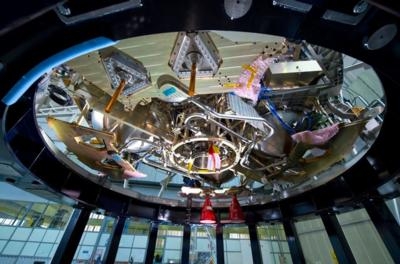
“The delivery of the structural test module marks an important milestone for the Orion programme and for Airbus Defense and Space, the first European supplier of a critical system to a crewed US mission in Space. I am very proud that the unequalled expertise of our teams, built-on the ATV successful missions, has been recognised and will be used over the next decades to contribute to the future crewed deep space missions,” said François Auque, Head of Space Systems.
After the initial static tests of this structure at Thales Alenia Space plant in Turin, a series of dynamic tests essential for building the flying model of the Orion service module (ESM) will now be carried out at the NASA center. These tests simulate conditions such as the loads and stresses that occur during a launch. In addition, the test results aim to determine whether structural and mass requirements are consistent with calculations and whether the service module satisfies NASA’s crew safety standards. The STA is an exact replica of the Orion service module, but without its functionality.
It is the first time that Europe has been involved in providing system-critical elements for a US crewed deep-space exploration project. In December 2012, NASA and the European Space Agency agreed to certify the European service module in conjunction with the new US Orion spacecraft. This module is based on the design and the lessons learned from the automated transfer vehicle (ATV), which was also developed and constructed by Airbus Defence and Space on behalf of ESA as a supply craft for the International Space Station.
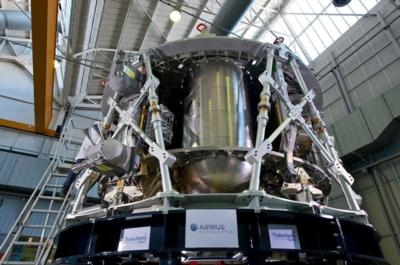
The plan is to use the Orion spacecraft for crewed missions to the Moon, to asteroids and into the depths of space. Lockheed Martin Space Systems is developing and building the space capsule for four or more astronauts on behalf of NASA. The ESM service module will propel the spacecraft, supply it with power and provide the main elements of its life support system.
Exploration Mission-1 will be Orion’s first planned unmanned mission to a Lunar distant retrograde orbit and return to Earth. The aim of this mission is not only to demonstrate the spacecraft’s performance capabilities before its crewed deployment, but also to achieve qualification for NASA’s new Space Launch System. As part of Exploration Mission-2, the Orion is then scheduled to be launched into space not earlier than 2020 with astronauts on board.
(Images provided with Airbus Defense and Space news release)
More News
Decision Altitude (DA) A specified altitude (mean sea level (MSL)) on an instrument approach procedure (ILS, GLS, vertically guided RNAV) at which the pilot must decide whether to >[...]
Aero Linx: T-34 Association, Inc. The T-34 Association was formed in July 1975 so that individuals purchasing then military surplus T-34As had an organization which would provide s>[...]
As He Released The Brakes To Begin Taxiing, The Brake Pedals Went To The Floor With No Braking Action Analysis: The pilot reported that during engine start up, he applied the brake>[...]
“Legislation like the Mental Health in Aviation Act is still imperative to hold the FAA accountable for the changes they clearly acknowledge need to be made... We cannot wait>[...]
Also: IAE Acquires Diamond Trainers, Army Drones, FedEx Pilots Warning, DA62 MPP To Dresden Tech Uni The danger to the flight training industry and our future pilots is clear. Dona>[...]



 ANN's Daily Aero-Term (12.08.25): Decision Altitude (DA)


 See All