

NASA's Mars Helicopter Attached To Mars 2020 Rover | Aero-News Network
Aero-News Network
RSS icon RSS feed
podcast icon MP3 podcast
Subscribe Aero-News e-mail Newsletter Subscribe

Airborne Unlimited -- Most Recent Daily Episodes

Episode Date

Airborne-Monday

Airborne-Tuesday

Airborne-Wednesday Airborne-Thursday

Airborne-Friday

Airborne On YouTube

Airborne-Unlimited-12.01.25

AirborneNextGen-
11.18.25

Airborne-Unlimited-11.19.25

Airborne-AffordableFlyers-11.20.25

AirborneUnlimited-11.21.25

LIVE MOSAIC Town Hall (Archived): www.airborne-live.net

Sun, Sep 01, 2019

NASA's Mars Helicopter Attached To Mars 2020 Rover

Will Be The First Aircraft To Fly On Another Planet

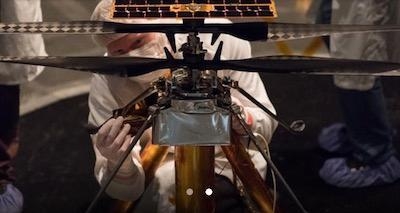
Engineers have attached NASA's Mars Helicopter, which will be the first aircraft to fly on another planet, to the belly of the Mars 2020 rover in the High Bay 1 clean room at the Jet Propulsion Laboratory in Pasadena, CA.

The twin-rotor, solar-powered helicopter was connected, along with the Mars Helicopter Delivery System, to a plate on the rover's belly that includes a cover to shield the helicopter from debris during entry, descent and landing. The helicopter will remain encapsulated after landing, deploying to the surface once a suitable area to conduct test flights is found at Jezero Crater, the rover's destination.

The Mars Helicopter is considered a high-risk, high-reward technology demonstration. If the small craft encounters difficulties, the science-gathering of the Mars 2020 mission won't be impacted. If the helicopter does take flight as designed, future Mars missions could enlist second-generation helicopters to add an aerial dimension to their explorations.

"Our job is to prove that autonomous, controlled flight can be executed in the extremely thin Martian atmosphere," said JPL's MiMi Aung, the Mars Helicopter project manager. "Since our helicopter is designed as a flight test of experimental technology, it carries no science instruments. But if we prove powered flight on Mars can work, we look forward to the day when Mars helicopters can play an important role in future explorations of the Red Planet."

Along with investigating difficult-to-reach destinations such as cliffs, caves and deep craters, they could carry small science instruments or act as scouts for human and robotic explorers. The agency intends to establish a sustained human presence on and around the Moon through NASA's Artemis lunar exploration plans, using the Moon as a stepping stone to putting humans on Mars.

"The Wright Brothers flew the first airplane at Kitty Hawk, North Carolina, but they built it in Dayton," said NASA Administrator Jim Bridenstine. "The Mars Helicopter, destined to be the first aircraft to fly on another world, was built in Pasadena, California. Joined now to the 2020 rover, it is yet another example of how NASA's Artemis generation is expanding humanity's reach in our solar system."

"With this joining of two great spacecraft, I can say definitively that all the pieces are in place for a historic mission of exploration," said Thomas Zurbuchen, associate administrator of the Science Mission Directorate at NASA's headquarters in Washington. "Together, Mars 2020 and the Mars Helicopter will help define the future of science and exploration of the Red Planet for decades to come."

The Mars 2020 rover, with the Mars Helicopter aboard, will launch on a United Launch Alliance Atlas V rocket in July 2020 from Space Launch Complex 41 at Cape Canaveral Air Force Station in Florida. When it lands at Jezero Crater on Feb. 18, 2021, the rover will be the first spacecraft in the history of planetary exploration with the ability to accurately retarget its point of touchdown during the landing sequence.

JPL is building and will manage operations of the Mars 2020 rover and the Mars Helicopter for NASA. NASA's Launch Services Program, based at the agency's Kennedy Space Center in Florida, is responsible for launch management. Lockheed Martin Space provided the Mars Helicopter Delivery System.

(Images provided with NASA news release)

FMI: www.nasa.gov

Advertisement

More News

ANN's Daily Aero-Term (11.28.25): Unmanned Aircraft System (UAS)

Unmanned Aircraft System (UAS) An unmanned aircraft and its associated elements related to safe operations, which may include control stations (ground, ship, or air based), control>[...]

ANN's Daily Aero-Linx (11.28.25)

Aero Linx: Cactus Fly-In The Classic Airplane Association of Arizona, Inc. (CAAA) was incorporated in Arizona as a not for profit corporation on January 10, 2014. The CAAA roster i>[...]

Airborne 11.21.25: NTSB on UPS Accident, Shutdown Protections, Enstrom Update

Also: UFC Buys Tecnams, Emirates B777-9 Buy, Allegiant Pickets, F-22 And MQ-20 The NTSB's preliminary report on the UPS Flight 2976 crash has focused on the left engine pylon's sep>[...]

Airborne 11.26.25: Bonanza-Baron Fini, Archer v LA NIMBYs, Gogo Loses$$$

Also: Bell 505 on SAF, NYPA Gets Flak For BizAv 'Abuse', FAA Venezuela Caution, Horizon Update Textron Aviation has confirmed it will be ending production of the Beechcraft Bonanza>[...]

Airborne-NextGen 11.25.25: EHang Manned Flt, Army UAVs, Starship V3 Booster Boom

Also: FedEx SAF, Archer Midnight Powertrain Tech, Rocket Lab Record, Perseverance Rover Find EHang has logged a major milestone in the development of its pilotless air taxi, loggin>[...]

blog comments powered by Disqus



Advertisement

Advertisement

Podcasts

Advertisement

© 2007 - 2025 Web Development & Design by Pauli Systems, LC

