
NASA Research Could Lead to Better, Safer Wings | Aero-News Network
Aero-News Network
RSS icon RSS feed
podcast icon MP3 podcast
Subscribe Aero-News e-mail Newsletter Subscribe

Airborne Unlimited -- Most Recent Daily Episodes

Episode Date

Airborne-Monday

Airborne-Tuesday

Airborne-Wednesday Airborne-Thursday

Airborne-Friday

Airborne On YouTube

Airborne-Unlimited-11.24.25

AirborneNextGen-
11.18.25

Airborne-Unlimited-11.19.25

Airborne-AffordableFlyers-11.20.25

AirborneUnlimited-11.21.25

LIVE MOSAIC Town Hall (Archived): www.airborne-live.net

Wed, Nov 01, 2017

NASA Research Could Lead to Better, Safer Wings

Instruments Will Monitor Flight Loads On PAT Wing

A uniquely instrumented wing will allow researchers to investigate advanced methods of monitoring flight loads, which could lead to improved flight safety.

The Passive Aeroelastic Tailored, or PAT, wing is expected to arrive later this year at NASA Armstrong Flight Research Center in California. The uniquely designed composite wing is lighter, more structurally efficient and has flexibility compared to conventional wings, said Larry Hudson, Armstrong Flight Loads Laboratory chief test engineer.

The layout of the fibers that make up the PAT wing are specially tailored and the performance of that design will be validated during these tests. Future commercial aircraft could use this wing building design to maximize structural efficiency, reduce weight and conserve fuel.  “It’s called a passive tailored wing because the structural efficiency is contained within the construction of the wing, it’s not an active system that is controlling the structural efficiency of the wing, it’s the composite layout,” Hudson explained.

The PAT wing was developed by Aurora Flight Sciences of Virginia and fabricated at the company’s manufacturing plant in Mississippi. The project is funded by the Aeronautics Research Mission Directorate through the Advanced Air Transport Technology project.

Until the PAT wing arrives, loads lab staff are working on the Calibration Research Wing, or CREW, in a similar test fixture for proficiency testing. CREW will be used as a pathfinder for the PAT wing. The two wings share similar instrumentation layout and collect similar data, which is why the CREW wing is a valuable hands-on dry run to collect data, learning how to analyze data and complete calibrations.

One of the major differences in the test architecture is the overhead loading system required to handle the significantly larger wing tip displacement inherent with the longer and more flexible PAT wing.

Another research item is the extensive use of the Fiber Optic Sensing System, or FOSS, technology. FOSS will enable faster and more economical loads calibration of the wings in the future. FOSS uses hair-like optical fibers that are bonded to the wing’s surface and can provide thousands of strain measurements to determine wing shape and distributed load.  “We will look at the limits of FOSS and how to maximize its use to help reduce the cost and schedule of loads calibration testing,” Hudson said.

Davis-Monthan Air Force Base in Arizona provided the MQ-9 (same kind of aircraft as NASA’s Ikhana) wing that serves as the CREW testbed. In 2007, Ikhana was the first large aircraft to fly with FOSS at Armstrong.

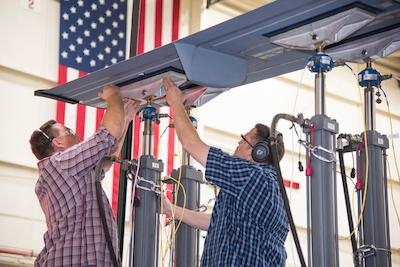
(Image provided with NASA news release. Jacob Roepel and Aaron Rumsey set the load pads for the calibration research wing, or CREW)

FMI: www.nasa.gov

Advertisement

More News

ANN's Daily Aero-Term (11.28.25): Unmanned Aircraft System (UAS)

Unmanned Aircraft System (UAS) An unmanned aircraft and its associated elements related to safe operations, which may include control stations (ground, ship, or air based), control>[...]

ANN's Daily Aero-Linx (11.28.25)

Aero Linx: Cactus Fly-In The Classic Airplane Association of Arizona, Inc. (CAAA) was incorporated in Arizona as a not for profit corporation on January 10, 2014. The CAAA roster i>[...]

Airborne 11.21.25: NTSB on UPS Accident, Shutdown Protections, Enstrom Update

Also: UFC Buys Tecnams, Emirates B777-9 Buy, Allegiant Pickets, F-22 And MQ-20 The NTSB's preliminary report on the UPS Flight 2976 crash has focused on the left engine pylon's sep>[...]

Airborne 11.26.25: Bonanza-Baron Fini, Archer v LA NIMBYs, Gogo Loses$$$

Also: Bell 505 on SAF, NYPA Gets Flak For BizAv 'Abuse', FAA Venezuela Caution, Horizon Update Textron Aviation has confirmed it will be ending production of the Beechcraft Bonanza>[...]

Airborne-NextGen 11.25.25: EHang Manned Flt, Army UAVs, Starship V3 Booster Boom

Also: FedEx SAF, Archer Midnight Powertrain Tech, Rocket Lab Record, Perseverance Rover Find EHang has logged a major milestone in the development of its pilotless air taxi, loggin>[...]

blog comments powered by Disqus



Advertisement

Advertisement

Podcasts

Advertisement

© 2007 - 2025 Web Development & Design by Pauli Systems, LC

