
Australian Safety Notice Places Emphasis on Sliding-Seat Issues With Sling 2 | Aero-News Network
Aero-News Network
RSS icon RSS feed
podcast icon MP3 podcast
Subscribe Aero-News e-mail Newsletter Subscribe

Airborne Unlimited -- Most Recent Daily Episodes

Episode Date

Airborne-Monday

Airborne-Tuesday

Airborne-Wednesday Airborne-Thursday

Airborne-Friday

Airborne On YouTube

Airborne-Unlimited-12.08.25

AirborneNextGen-
12.09.25

Airborne-Unlimited-12.10.25

Airborne-AffordableFlyers-12.11.25

AirborneUnlimited-12.05.25

AFE 2025 LIVE MOSAIC Town Hall (Archived): www.airborne-live.net

Fri, May 12, 2023

Australian Safety Notice Places Emphasis on Sliding-Seat Issues With Sling 2

CASA Reminds Pilots to Check their Seat Rails for Proper Locking Capability 

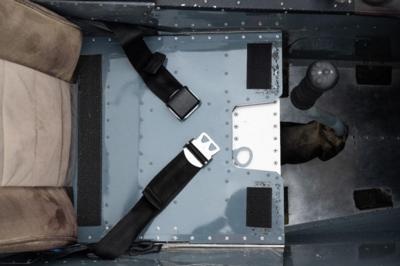
A reminder from the Australian Transport Safety Bureau brought a classic Cessna bugbear to the fore with a review of a recent incident during takeoff, this time in a Sling 2 taking off for a training flight.

Luckily the incident did not turn out poorly for the student pilot, who was starting off their very first solo flight when the seat locking mechanism unlatched, dumping them backwards upon rotation. The incident highlights a bit of the convenience of a floor-mounted stick, since all it required was the reduction of throttle and some hand braking to bring the Sling 2 back to rest without leaving the runway. As many in the GA community know, an unlatched seat can turn quite deadly when the pilot reflexively pulls on the yoke to stay in position. Such an accident occurred in Queensland in 2014, when a Cessna 206 stalled after takeoff and fatally injured 5. In that incident, the Bureau suspected that the pilot seat’s rear rail stop was not fitted, allowing the seat base to disengage from the rear of the seat rails. 

The problem has been a pretty consistent issue in the Cessna community, with the Aussie FAA equivalent publishing an airworthiness bulletin in line with the rest of the world in 2018. CASA warned all single-engine Cessna operators about the vital importance of “meticulous inspection and timely maintenance to ensure pilot seats, adjustment mechanisms, and seat track locking mechanisms are secured correctly to prevent inadvertent seat movement, particularly during critical phases of flight.”

The occurrence of the same phenomenon in a non-Cessna aircraft, while not quite the first thing that comes to mind, is something to be noted and guarded against, no matter the make and model.

FMI: www.atsb.gov.au

Advertisement

More News

ANN's Daily Aero-Term (12.08.25): Decision Altitude (DA)

Decision Altitude (DA) A specified altitude (mean sea level (MSL)) on an instrument approach procedure (ILS, GLS, vertically guided RNAV) at which the pilot must decide whether to >[...]

ANN's Daily Aero-Linx (12.08.25)

Aero Linx: T-34 Association, Inc. The T-34 Association was formed in July 1975 so that individuals purchasing then military surplus T-34As had an organization which would provide s>[...]

NTSB Final Report: Piper PA-31T3

As He Released The Brakes To Begin Taxiing, The Brake Pedals Went To The Floor With No Braking Action Analysis: The pilot reported that during engine start up, he applied the brake>[...]

Aero-News: Quote of the Day (12.08.25)

“Legislation like the Mental Health in Aviation Act is still imperative to hold the FAA accountable for the changes they clearly acknowledge need to be made... We cannot wait>[...]

Airborne-Flight Training 12.04.25: Ldg Fee Danger, Av Mental Health, PC-7 MKX

Also: IAE Acquires Diamond Trainers, Army Drones, FedEx Pilots Warning, DA62 MPP To Dresden Tech Uni The danger to the flight training industry and our future pilots is clear. Dona>[...]

blog comments powered by Disqus



Advertisement

Advertisement

Podcasts

Advertisement

© 2007 - 2025 Web Development & Design by Pauli Systems, LC

