Fri, Apr 12, 2019
Maxar And NASA On Track To Make History As First-Ever To Refuel Satellite In Low Earth Orbit
Maxar Technologies has announced that the spacecraft bus it is building for NASA's Restore-L project to refuel a satellite in Low Earth Orbit (LEO) has completed an important review process called the Critical Design Review (CDR). With the CDR complete, the spacecraft bus is on track to ship to NASA in 2020 for integration with the robotic payload and a forecasted launch in 2022. Maxar is also building both nimble robotic arms for the Restore-L spacecraft, which will capture, manipulate and refuel the Landsat 7 satellite.
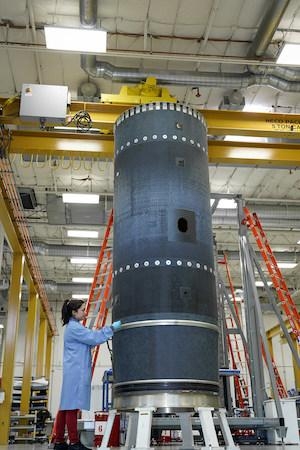
As previously announced, Maxar is working with NASA Goddard Space Flight Center's Satellite Servicing Projects Division (SSPD) to build a spacecraft that will rendezvous with, refuel, and safely release the U.S. Geological Survey's Landsat 7 remote sensing satellite in LEO. Restore-L is funded by NASA's Space Technology Mission Directorate. In addition to demonstrating the ability to refuel a satellite that was not designed to be serviced, Restore-L aims to validate the use of tools, technologies and techniques developed to enable future exploration missions and jumpstart a new satellite servicing industry for government and commercial customers.
The CDR took place over a five-day period at Maxar's Silicon Valley manufacturing facility and demonstrated that the company's spacecraft bus design meets mission requirements. NASA missions undergo multiple rigorous technical and programmatic reviews as they proceed through the phases of development prior to launch. The CDR is the third of six major NASA mission milestones, culminating with the spacecraft's launch.
The Maxar-built Restore-L spacecraft bus will provide the structural support, propulsion, attitude control, data and communications interface and power to support the Restore-L robotic payload for the on-orbit demonstration. The spacecraft design is based on Maxar's decades-proven 1300-class platform, which has the flexibility and power to enable a broad range of missions and technology advances.
"The technologies proven on Restore-L are of great value to future exploration and science missions, and will play a crucial role in enabling our exploration of the Moon and beyond," said Mike Edwards, Maxar's Senior vice president of Strategic Growth. "Satellite servicing is one of many disruptive technologies that Maxar is pioneering to provide our customers with expanded options for more resilient and cost-effective operations in space."
(Image provided with Maxar news release)
More News
Decision Altitude (DA) A specified altitude (mean sea level (MSL)) on an instrument approach procedure (ILS, GLS, vertically guided RNAV) at which the pilot must decide whether to >[...]
Aero Linx: T-34 Association, Inc. The T-34 Association was formed in July 1975 so that individuals purchasing then military surplus T-34As had an organization which would provide s>[...]
As He Released The Brakes To Begin Taxiing, The Brake Pedals Went To The Floor With No Braking Action Analysis: The pilot reported that during engine start up, he applied the brake>[...]
“Legislation like the Mental Health in Aviation Act is still imperative to hold the FAA accountable for the changes they clearly acknowledge need to be made... We cannot wait>[...]
Also: IAE Acquires Diamond Trainers, Army Drones, FedEx Pilots Warning, DA62 MPP To Dresden Tech Uni The danger to the flight training industry and our future pilots is clear. Dona>[...]



 ANN's Daily Aero-Term (12.08.25): Decision Altitude (DA)


 See All