

Army Awards Raytheon $13 Million To Improve Pilot's Situational Awareness | Aero-News Network
Aero-News Network
RSS icon RSS feed
podcast icon MP3 podcast
Subscribe Aero-News e-mail Newsletter Subscribe

Airborne Unlimited -- Most Recent Daily Episodes

Episode Date

Airborne-Monday

Airborne-Tuesday

Airborne-Wednesday Airborne-Thursday

Airborne-Friday

Airborne On YouTube

Airborne-Unlimited-12.08.25

AirborneNextGen-
12.09.25

Airborne-Unlimited-12.10.25

Airborne-AffordableFlyers-12.11.25

AirborneUnlimited-12.12.25

AFE 2025 LIVE MOSAIC Town Hall (Archived): www.airborne-live.net

Fri, Oct 09, 2009

Army Awards Raytheon $13 Million To Improve Pilot's Situational Awareness

Full Cockpit View, Other Aircraft Information In Helmet Display

The U.S. Army has awarded Raytheon a $13 million contract to develop additional sensor prototypes for the Advanced Distributed Aperture System, which gives helicopter pilots 360-degree situational awareness.

The award is the first extension of the Joint Capability Technology Demonstration contract, initially funded in September 2008. 

The Army launched the ADAS program to assist pilots flying at low altitudes. The original system provides up to six infrared sensors and a combined helmet display showing a full view of the cockpit and other parts of the helicopter, including the engines and tail rotor.

Additional capabilities to be provided by Raytheon include an indicator of hostile fire, landing-assist symbols that appear on the helmet display for operation in low visibility, and infrared search-and-track and three-dimensional audio systems.

"These new capabilities improve the helicopter pilot's situational awareness," said Tim Carey, vice president for Intelligence, Surveillance and Reconnaissance at Raytheon Space and Airborne Systems. "This high-resolution sensor system prototype has been demonstrated during test flights and has proved to provide the maneuverability and performance that our soldiers need."

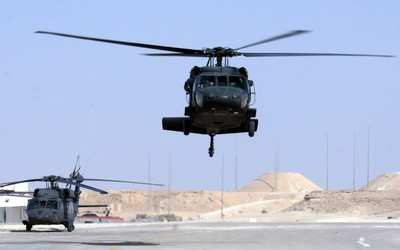
Raytheon has performed more than 120 hours of extensive ADAS testing to demonstrate the system's capabilities on a UH-60 Blackhawk helicopter.

File Photo

The system is one of several sensor technologies developed by the company. The Army awarded Raytheon the Objective Pilotage for Utility and Lift program in January 2008. Its primary objective is to develop an affordable lightweight sensor system solution. Depending on customer requirements, OPUL can provide up to five sensors for full situational awareness at low cost. Offering high-resolution images but with an uncooled lightweight sensor system, OPUL is designed primarily to be placed on rotary wing aircraft such as the UH-60 Blackhawk and the CH-47 Chinook.

FMI: www.army.mil, www.raytheon.com

Advertisement

More News

Aero-News: Quote of the Day (12.09.25)

“We respectfully call on the City of Mesa to: 1. Withdraw the landing fee proposal immediately 2. Engage with the aviation community before making decisions that impact safet>[...]

ANN's Daily Aero-Term (12.09.25): High Speed Taxiway

High Speed Taxiway A long radius taxiway designed and provided with lighting or marking to define the path of aircraft, traveling at high speed (up to 60 knots), from the runway ce>[...]

ANN's Daily Aero-Linx (12.09.25)

Aero Linx: International Federation of Airworthiness (IFA) IFA uniquely combines together all those with responsibility for policies, principles and practices concerned with the co>[...]

NTSB Final Report: Diamond Aircraft Ind Inc DA20C1 (A1); Robinson Helicopter R44

Controller’s Expectation That VW02 Would Have Departed Sooner Led To An Inadequate Scan And Loss Of Situational Awareness Analysis: A Robinson R-44 helicopter N744AF, VW02 (V>[...]

ANN FAQ: Q&A 101

A Few Questions AND Answers To Help You Get MORE Out of ANN! 1) I forgot my password. How do I find it? 1) Easy... click here and give us your e-mail address--we'll send it to you >[...]

blog comments powered by Disqus



Advertisement

Advertisement

Podcasts

Advertisement

© 2007 - 2025 Web Development & Design by Pauli Systems, LC

