Fri, Oct 12, 2018
Prerequisite For Carrier Operations Aboard The USS Gerald R. Ford
Advanced Arresting Gear (AAG) performance testing has been successfully completed for the C-2A Greyhound, E-2C+ Hawkeye, and E-2D Advanced Hawkeye aircraft by General Atomics Electromagnetic Systems (GA-EMS). The testing supports the Navy’s development of a propeller Aircraft Recovery Bulletin (ARB), which is a prerequisite for arresting propeller aircraft aboard USS Gerald R. Ford (CVN 78). The Navy completed the performance testing of the GA-EMS system on the Runway Arrested Landing Site (RALS) at Joint Base McGuire-Dix-Lakehurst in New Jersey.
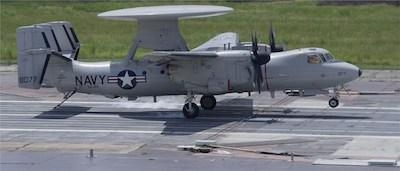
“The AAG system is designed to arrest a broader range of aircraft and provide higher reliability and safety margins for the U.S. Navy’s Ford-class of aircraft carriers,” stated Rolf Ziesing, vice president of Programs at GA-EMS. “As each aircraft is brought in for testing, AAG continues to perform reliably, arrestment after arrestment. The successful turboprop arrestments at RALS mark another significant milestone that moves the Navy closer to initiating recovery testing for these aircraft aboard CVN 78.”
The AAG system has been exercised extensively, with more than 800 total roll-in and fly-in aircraft arrestments successfully performed at RALS. In addition, nearly double the approximately 400 planned at-sea F/A-18 E/F Super Hornet recoveries during sea trials and shakedown have been completed aboard CVN 78. GA-EMS continues to collaborate closely with NAVAIR and the shipbuilder to optimize the AAG system and the Electromagnetic Aircraft Launch System (EMALS), and support upgrades during the CVN 78 Post Shakedown Availability (PSA).
“We continue to stress the system, analyze results, and tune the system to ensure maximum performance,” stated Dean Key, senior director of EMALS/AAG programs at GA-EMS. “We are on target to be ready for fleet operations when CVN 78 completes its PSA in 2019. We are pleased with AAG’s performance, and remain focused on optimizing the system’s capabilities to meet the daily operations and mission requirements for CVN 78 and the next two Ford-class carriers currently under construction.”
AAG is a turbo-electric system designed for controlled deceleration of aircraft. AAG is installed aboard CVN 78 along with EMALS, which uses electromagnetic technology to launch aircraft from the deck of naval aircraft carriers. Both systems have been successfully tested during at-sea periods aboard CVN 78, and are currently in production for the future John F. Kennedy (CVN 79) and Enterprise (CVN 80) aircraft carriers.
(Image provided with General Atomics news release)
More News
Decision Altitude (DA) A specified altitude (mean sea level (MSL)) on an instrument approach procedure (ILS, GLS, vertically guided RNAV) at which the pilot must decide whether to >[...]
Aero Linx: T-34 Association, Inc. The T-34 Association was formed in July 1975 so that individuals purchasing then military surplus T-34As had an organization which would provide s>[...]
As He Released The Brakes To Begin Taxiing, The Brake Pedals Went To The Floor With No Braking Action Analysis: The pilot reported that during engine start up, he applied the brake>[...]
“Legislation like the Mental Health in Aviation Act is still imperative to hold the FAA accountable for the changes they clearly acknowledge need to be made... We cannot wait>[...]
Also: IAE Acquires Diamond Trainers, Army Drones, FedEx Pilots Warning, DA62 MPP To Dresden Tech Uni The danger to the flight training industry and our future pilots is clear. Dona>[...]



 ANN's Daily Aero-Term (12.08.25): Decision Altitude (DA)


 See All