Sets Additional Cert Requirements, Guidelines On Fuel
Recognizing that interest in diesel engines within the general
aviation community has grown appreciably in the past several years,
the Federal Aviation Administration has issued a draft memorandum
to clarify the certification requirements for 14 CFR part 33, type
certification of diesel reciprocating engines.
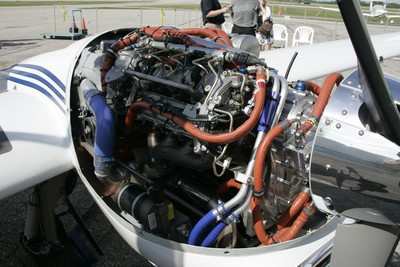
The memorandum, available for download as a Word file at the FMI
link below, provides compliance interpretations the agency says are
necessary to accommodate the unique design features of a diesel
reciprocating engine. It also identifies areas of regulatory
compliance that may require equivalent level of safety findings
(ELOS) or special conditions (SC) to address design features of
diesel engines not envisioned when part 33 was created.
Despite the generalized guidelines, the FAA also states
appropriate ELOS or special conditions for each engine model must
be determined on a case-by-case basis, in accordance with part 21,
§§ 21.16, 21.17, and part 11.
"Interest in diesel aircraft engines has recently been renewed
in response to the demand for engines that do not require leaded
fuel for operation," the FAA states. "Two recent diesel engines
have been certified in Europe and validated by the FAA. Several
other diesel reciprocating engines are in development in both the
US and in Europe."
"There are many new and novel issues to be addressed as modern
diesel engine technology is integrated into these aircraft
engines," the agency adds.
Areas of compliance specific to diesel engines -- referred to as
compression ignition, or CI, engines -- include evaluation of a CI
engine's high-pressure fuel system, and ELOS determinations for
fuel flow and power level angles to be used in computing engine
operating limitations.
The traditional method for computing operating limits involves
measuring airflow into the engine through manifold air pressure
(MAP) sensors -- a system that may not provide accurate readings
for CI engines, as diesels do not meter airflow into the engine the
same way a conventional, or spark ignition (SI) engine does.
The memorandum also specifies guidelines for aviation-grade
diesel fuels. The FAA anticipates that in most cases, operators of
planes with CI engines will use either Jet-A, or automotive diesel
fuel in their engines.
However, aviation jet fuel specifications such as ASTM
International D1655 do not include criteria for control of cetane
number, because this is not a critical performance parameter for
turbine engines. In diesel engines, however, the cetane number is a
big deal, as it characterizes the ignition capability of a diesel
fuel, and is a critical parameter for assessing the acceptability
of a fuel for a particular engine design. Using the appropriate
cetane rated fuel in a diesel engine is critical to developing the
appropriate power.
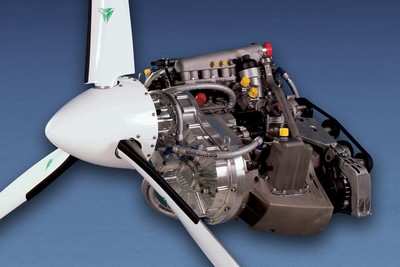
Therefore, the FAA mandates that a CI engine applicant will be
required to provide an analysis that shows operation with jet fuel
with an inadequate cetane number will not create an unsafe
condition. The agency also says the applicant's analysis should
consider the minimum cetane requirement of their CI engine design,
the probability that commercially available fuel may have a cetane
number below that minimum, and the consequences of operating with a
fuel with a cetane number that is below that minimum.
The FAA also specifies CI engines must meet similar standards
for icing protection as turbine engines, as diesel fuel absorbs
more water than regular avgas does.



 Aero-News: Quote of the Day (12.09.25)


 See All