
Orion Exploration Mission-1 Crew Module Pressure Tested | Aero-News Network
Aero-News Network
RSS icon RSS feed
podcast icon MP3 podcast
Subscribe Aero-News e-mail Newsletter Subscribe

Airborne Unlimited -- Most Recent Daily Episodes

Episode Date

Airborne-Monday

Airborne-Tuesday

Airborne-Wednesday Airborne-Thursday

Airborne-Friday

Airborne On YouTube

Airborne-Unlimited-12.08.25

AirborneNextGen-
12.09.25

Airborne-Unlimited-12.10.25

Airborne-AffordableFlyers-12.11.25

AirborneUnlimited-12.05.25

AFE 2025 LIVE MOSAIC Town Hall (Archived): www.airborne-live.net

Thu, May 12, 2016

Orion Exploration Mission-1 Crew Module Pressure Tested

Spacecraft Approved for Assembly Of Secondary Structures

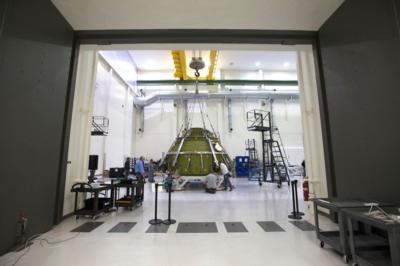
The NASA Orion team has successfully proof-pressure tested the Orion spacecraft's Exploration Mission-1 (EM-1) crew module. The crew module is the living quarters for astronauts and the backbone for many of Orion's systems such as propulsion, avionics and parachutes.

In order to certify the structural integrity of the crew module it was outfitted with approximately 850 instruments and subjected to 1.25 times the maximum pressure the capsule is expected to experience during its deep space missions. That means about 20 pounds per square inch of pressure was distributed over the entire inner surface of the spacecraft trying to burst it from within. As a next step, the team will use phased array technology to inspect all of the spacecraft's welds in order to ensure there are no defects.

Once the primary structure of the crew module has been verified, the team will begin the installation of secondary structures such as tubes, tanks and thrusters. Once those pieces are in place, the crew module will be moved into the clean room and the propulsion and environmental control and life support systems will be installed.

"Our experience building and flying Exploration Flight Test-1 has allowed us to improve the build and test process for the EM-1 crew module," said Mike Hawes, Lockheed Martin Orion vice president and program manager. "Across the program we are establishing efficiencies that will decrease the production time and cost of future Orion spacecraft."

During EM-1 Orion will be launched atop NASA's Space Launch System (SLS) for the first time. The test flight will send Orion into lunar distant retrograde orbit - a wide orbit around the moon that is farther from Earth than any human-rated spacecraft has ever traveled. The mission will last about three weeks and will certify the design and safety of Orion and SLS for future human-rated exploration missions.

(Image provided with Lockheed Martin news release)

FMI: www.lockheedmartin.com, www.nasa.com

Advertisement

More News

ANN's Daily Aero-Term (12.08.25): Decision Altitude (DA)

Decision Altitude (DA) A specified altitude (mean sea level (MSL)) on an instrument approach procedure (ILS, GLS, vertically guided RNAV) at which the pilot must decide whether to >[...]

ANN's Daily Aero-Linx (12.08.25)

Aero Linx: T-34 Association, Inc. The T-34 Association was formed in July 1975 so that individuals purchasing then military surplus T-34As had an organization which would provide s>[...]

NTSB Final Report: Piper PA-31T3

As He Released The Brakes To Begin Taxiing, The Brake Pedals Went To The Floor With No Braking Action Analysis: The pilot reported that during engine start up, he applied the brake>[...]

Aero-News: Quote of the Day (12.08.25)

“Legislation like the Mental Health in Aviation Act is still imperative to hold the FAA accountable for the changes they clearly acknowledge need to be made... We cannot wait>[...]

Airborne-Flight Training 12.04.25: Ldg Fee Danger, Av Mental Health, PC-7 MKX

Also: IAE Acquires Diamond Trainers, Army Drones, FedEx Pilots Warning, DA62 MPP To Dresden Tech Uni The danger to the flight training industry and our future pilots is clear. Dona>[...]

blog comments powered by Disqus



Advertisement

Advertisement

Podcasts

Advertisement

© 2007 - 2025 Web Development & Design by Pauli Systems, LC

