Little Information Gleaned From Initial Inspection Of Wreckage,
Communications
The NTSB's preliminary report in the February 3rd accident which
fatally injured Micron CEO Steve Appleton offers little in the way
of insight as to what may have occurred during the flight. It will
apparently take some time for the board's investigators to sort
through this one to arrive at a probable cause.

NTSB Identification: WPR12FA089
14 CFR Part 91: General Aviation
Accident occurred Friday, February 03, 2012 in Boise, ID
Aircraft: GARZA CARLOS LANCAIR IVP-TP, registration: N321LC
Injuries: 1 Fatal.
This is preliminary information, subject to change, and may
contain errors. Any errors in this report will be corrected when
the final report has been completed.
On February 03, 2012, at 0856 MST, a single-engine experimental
Lancair IVP-TP, N321LC, impacted terrain while on the initial
takeoff climb from Gowen Field, Boise, Idaho. The air transport
pilot, the sole occupant, was fatally injured. The airplane was
registered to Raleighwood Aviation LLC and was being operated by
the pilot under the provisions of 14 Code of Federal Regulations
Part 91. The personal flight was originating from Boise and the
pilot had intended to stay in the airport's traffic pattern. Visual
meteorological conditions prevailed and no flight plan had been
filed.
Numerous witnesses located at the airport observed the airplane
on the first takeoff attempt and on the subsequent accident flight.
A majority of them stated that the airplane initially departed 10R
and climbed to about 5 to 10 feet above ground level (agl) before
touching back down on the runway. The pilot taxied back toward the
west end of the airport. Shortly thereafter, the airplane departed
10R again and began the initial climb to about 100 to 200 feet agl.
It then made a steep bank to the left and began to roll while
rapidly losing altitude. The airplane completed about one
revolution and impacted terrain in a nose-low attitude. The
airplane came to rest in a dirt area between the parallel runways
10R and 10L.
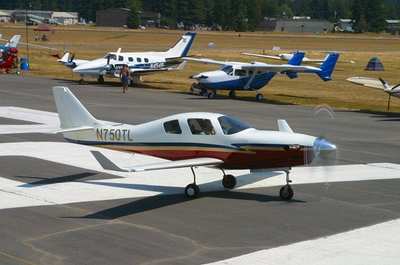
File Photo
The Boise Air Traffic Control Facility provided the recorded
radio communications between the pilot and controllers. The pilot
was initially cleared and departed from runway 10R about 0846. He
transmitted to the controller that “we're going to land here
and stop… we’ve got a problem,” followed by
“I am going to taxi back and see if I can figure it
out.” About 7 minutes later he told the controller that he
would like to depart and stay in the traffic pattern. About 0855 he
made his last transmission when he requested that he would
“like to turn back in and… um… land…
coming back in.”
The first identified point of impact consisted of a crater in
the soft terrain where a propeller blade was imbedded; small pieces
of airframe and debris surrounded the disrupted dirt. Numerous
portions of the airframe were located in the debris field leading
from the initial impact to the main wreckage, the largest of which
was a majority of the right wing. The main wreckage was located
about 80 feet from the initial impact on a magnetic heading of 046
degrees. The main wreckage had sustained thermal damage and
consisted of the engine, inboard portion of the left wing, and
fuselage (from firewall to aft bulkhead).
A complete airframe teardown examination has been completed. The
engine, engine accessories, and three recording devices have been
retained for further investigation.



 Aero-News: Quote of the Day (12.11.25)


 See All