

NASA, Uber To Explore Safety, Efficiency Of Future Urban Airspace | Aero-News Network
Aero-News Network
RSS icon RSS feed
podcast icon MP3 podcast
Subscribe Aero-News e-mail Newsletter Subscribe

Airborne Unlimited -- Most Recent Daily Episodes

Episode Date

Airborne-Monday

Airborne-Tuesday

Airborne-Wednesday Airborne-Thursday

Airborne-Friday

Airborne On YouTube

Airborne-Unlimited-12.08.25

AirborneNextGen-
12.09.25

Airborne-Unlimited-12.10.25

Airborne-AffordableFlyers-12.11.25

AirborneUnlimited-12.12.25

AFE 2025 LIVE MOSAIC Town Hall (Archived): www.airborne-live.net

Thu, May 10, 2018

NASA, Uber To Explore Safety, Efficiency Of Future Urban Airspace

Second Space Act Agreement Signed Between The Two Entities

NASA has signed a second space act agreement with Uber Technologies, Inc., to further explore concepts and technologies related to urban air mobility (UAM) to ensure a safe and efficient system for future air transportation in populated areas.  

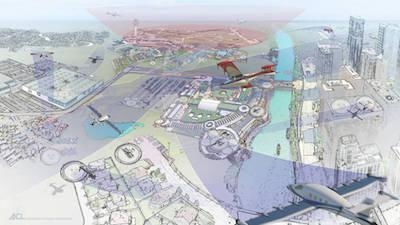
Under this agreement, Uber will share its plans for implementing an urban aviation rideshare network. NASA will use the latest in airspace management computer modeling and simulation to assess the impacts of small aircraft – from delivery drones to passenger aircraft with vertical take-off and landing capability – in crowded environments.

This is NASA’s first such agreement specifically focused on modeling and simulation for UAM operations.

“NASA is excited to be partnering with Uber and others in the community to identify the key challenges facing the UAM market, and explore necessary research, development and testing requirements to address those challenges,” said Jaiwon Shin, associate administrator for NASA’s Aeronautics Research Mission Directorate. “Urban air mobility could revolutionize the way people and cargo move in our cities and fundamentally change our lifestyle much like smart phones have.”

At its research facility at the Dallas Fort Worth (DFW) International Airport, NASA will use the data supplied by Uber to simulate a small passenger-carrying aircraft as it flies through DFW airspace during peak scheduled air traffic. Analysis of these simulations will identify safety issues as these new aircraft take to the air in an already crowded air traffic control system.

"The new space act agreement broadening Uber's partnership with NASA is exciting, because it allows us to combine Uber's massive-scale engineering expertise with NASA's decades of subject matter experience across multiple domains that are key to enabling urban air mobility, starting with airspace systems," said Jeff Holden, Uber’s chief product officer.

As small aircraft enter the marketplace, NASA wants to ensure they do so safely, with acceptable levels of noise, and without burdening the current national air traffic control system. To this end, the agency is leveraging ongoing aeronautics research in areas including: Unmanned Aircraft System (UAS) traffic management at low altitude; UAS integration in the National Airspace System; all-electric, general aviation class aircraft development; vertical take-off and landing aircraft; system-wide safety; and more.

These activities will generate the data necessary to support the creation of industry standards, Federal Aviation Administration rules and procedures, and other related regulations. NASA will make the research available to the broader UAM community.

(Images provided with NASA news release)

FMI: go.nasa.gov/2I04Ec1

Advertisement

More News

Aero-News: Quote of the Day (12.09.25)

“We respectfully call on the City of Mesa to: 1. Withdraw the landing fee proposal immediately 2. Engage with the aviation community before making decisions that impact safet>[...]

ANN's Daily Aero-Term (12.09.25): High Speed Taxiway

High Speed Taxiway A long radius taxiway designed and provided with lighting or marking to define the path of aircraft, traveling at high speed (up to 60 knots), from the runway ce>[...]

ANN's Daily Aero-Linx (12.09.25)

Aero Linx: International Federation of Airworthiness (IFA) IFA uniquely combines together all those with responsibility for policies, principles and practices concerned with the co>[...]

NTSB Final Report: Diamond Aircraft Ind Inc DA20C1 (A1); Robinson Helicopter R44

Controller’s Expectation That VW02 Would Have Departed Sooner Led To An Inadequate Scan And Loss Of Situational Awareness Analysis: A Robinson R-44 helicopter N744AF, VW02 (V>[...]

ANN FAQ: Q&A 101

A Few Questions AND Answers To Help You Get MORE Out of ANN! 1) I forgot my password. How do I find it? 1) Easy... click here and give us your e-mail address--we'll send it to you >[...]

blog comments powered by Disqus



Advertisement

Advertisement

Podcasts

Advertisement

© 2007 - 2025 Web Development & Design by Pauli Systems, LC

