

NASA Awards First Stage Contract For Ares Rocket | Aero-News Network
Aero-News Network
RSS icon RSS feed
podcast icon MP3 podcast
Subscribe Aero-News e-mail Newsletter Subscribe

Airborne Unlimited -- Most Recent Daily Episodes

Episode Date

Airborne-Monday

Airborne-Tuesday

Airborne-Wednesday Airborne-Thursday

Airborne-Friday

Airborne On YouTube

Airborne-Unlimited-12.08.25

AirborneNextGen-
12.09.25

Airborne-Unlimited-12.10.25

Airborne-AffordableFlyers-12.11.25

AirborneUnlimited-12.12.25

AFE 2025 LIVE MOSAIC Town Hall (Archived): www.airborne-live.net

Sat, Aug 11, 2007

NASA Awards First Stage Contract For Ares Rocket

Agency's NextGen Manned Space Program Comes Together

NASA has signed a $1.8 billion contract with Alliant Techsystems, known as ATK, located near Brigham City, UT for the design, development, testing, and evaluation of the first stage of the Ares I and Ares V launch vehicles.

This contract continues work that began on April 17, 2006, and includes delivery of five ground static test motors, two ground vibration test articles and four flight test stages, including one for the Ares I-X test flight.

NASA awarded the cost-plus-award-fee contract to ATK on a sole-source basis. The contract performance period extends through December 31, 2014. First stage boosters for operational missions will be purchased through a separate contract.

NASA tells ANN that ATK and its subcontractors possess the unique engineering capabilities for successful design and development of the first stage of the Ares I crew launch vehicle, based on their current work providing space shuttle solid rocket boosters.

The SRBs are the only such systems manufactured in the United States that possesses both the required capabilities and safety margins necessary for the launch of a human-rated exploration space vehicle.

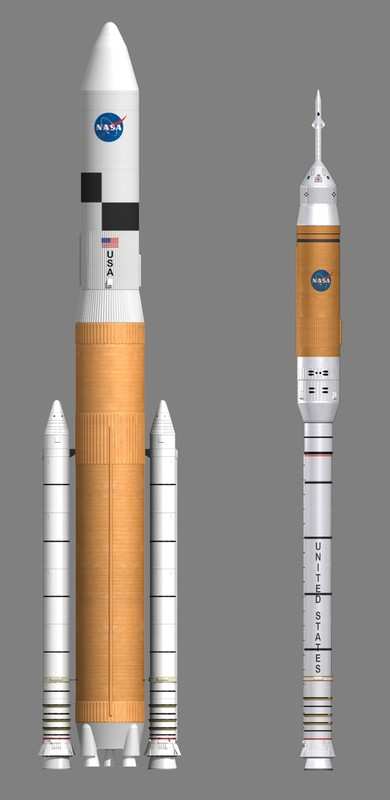
The Ares I first stage will be a five-segment solid rocket booster based on the four-segment design used for the shuttle. The basic design will draw on current hardware, facilities and manufacturing equipment qualified for human-rated solid rocket boosters.

The first stage will incorporate modifications to the current booster that are unique to the Ares I architecture to meet higher performance and reliability requirements for the Ares vehicles. Modifications include the additional segment and new solid rocket booster components.

Ares I is an in-line, two-stage rocket that will transport the Orion crew exploration vehicle to low Earth orbit. Orion will accommodate as many as six astronauts. The first stage will consist of the five-segment solid rocket booster. The second, or upper, stage will consist of a J-2X liquid-oxygen, liquid-hydrogen engine, a new upper stage fuel tank and associated avionics.

Ares V will enable NASA to launch a variety of science and exploration payloads, as well as key components, needed to travel to the moon and later to Mars. Ares V, a heavy-lift launch vehicle, is currently projected to use five RS-68 liquid-oxygen, liquid-hydrogen engines mounted below a larger version of the shuttle's external tank and two five-segment, solid-propellant rocket boosters for the first stage. The upper stage will use the same J-2X engine as the Ares I.

The first stage is managed by NASA's Marshall Space Flight Center in Huntsville, AL for NASA's Constellation Program.

FMI: www.nasa.gov/constellation

Advertisement

More News

Aero-News: Quote of the Day (12.09.25)

“We respectfully call on the City of Mesa to: 1. Withdraw the landing fee proposal immediately 2. Engage with the aviation community before making decisions that impact safet>[...]

ANN's Daily Aero-Term (12.09.25): High Speed Taxiway

High Speed Taxiway A long radius taxiway designed and provided with lighting or marking to define the path of aircraft, traveling at high speed (up to 60 knots), from the runway ce>[...]

ANN's Daily Aero-Linx (12.09.25)

Aero Linx: International Federation of Airworthiness (IFA) IFA uniquely combines together all those with responsibility for policies, principles and practices concerned with the co>[...]

NTSB Final Report: Diamond Aircraft Ind Inc DA20C1 (A1); Robinson Helicopter R44

Controller’s Expectation That VW02 Would Have Departed Sooner Led To An Inadequate Scan And Loss Of Situational Awareness Analysis: A Robinson R-44 helicopter N744AF, VW02 (V>[...]

ANN FAQ: Q&A 101

A Few Questions AND Answers To Help You Get MORE Out of ANN! 1) I forgot my password. How do I find it? 1) Easy... click here and give us your e-mail address--we'll send it to you >[...]

blog comments powered by Disqus



Advertisement

Advertisement

Podcasts

Advertisement

© 2007 - 2025 Web Development & Design by Pauli Systems, LC

