Thu, Apr 12, 2012
Mission Will Study Black Holes, Neutron Stars, Other 'Extreme Phenomena'
An agreement has been signed by ESA and the Japanese Aerospace Exploration Agency (JAXA) for cooperation on Astro-H, an important mission that will provide a unique opportunity for probing extreme phenomena in the Universe. Astro-H will study astrophysical objects including black holes and neutron stars, explore the non-thermal Universe, and investigate the large-scale structure of the Universe and its evolution.
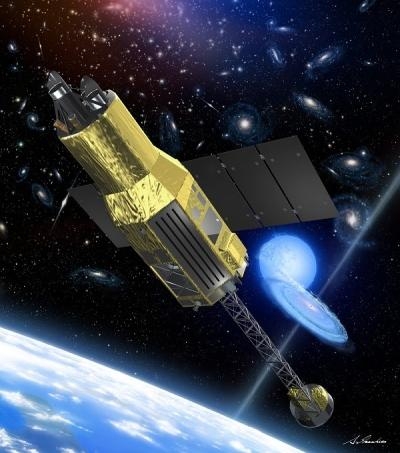
The agreement was signed on March 16 by Professor Alvaro Giménez Cañete, ESA Director of Science and Robotic Exploration, and Dr Junjiro Onoda, Director General of the Japanese Institute of Space and Astronautical Science (ISAS). The agreement will see ESA providing JAXA with hardware components and support for operations and users. In return, ESA will be granted observing time on the Astro-H mission, to be allocated to scientists at institutions in ESA Member States through an open Announcement of Opportunity.
JAXA’s Astro-H mission is the sixth in a series of successful X-ray missions initiated by ISAS in Japan, beginning with the launch of the Hakucho mission in 1979 through to the current Suzaku mission. Astro-H will investigate the physics of the high-energy Universe by performing high-resolution, high-throughput spectroscopy with moderate spatial resolution over the 0.3–600 keV energy range. The launch is planned for 2014 from Tanegashima Space Center.
The mission will carry a unique set of innovative instruments, which are:
- Soft and Hard X-ray Imagers (SXI and HXI) to provide imaging spectroscopy in the 0.4–80 keV energy range.
- A Soft Gamma-ray Detector (SGD) to provide high-sensitivity observations in the 40–600 keV energy range.
- An X-ray micro-calorimeter spectrometer (SXS-XCS) to provide fine spectroscopic capability over an energy range of 0.3–12 keV.
This agreement follows a long series of cooperations between ESA and JAXA in space science (ISO, Akari, BepiColombo), as well as cooperation between ESA and Japan in other fields, such as Earth observation (ALOS Date Node, EarthCARE), and telecommunications (Artemis/OICETS), and as partners of the International Space Station.
More News
Decision Altitude (DA) A specified altitude (mean sea level (MSL)) on an instrument approach procedure (ILS, GLS, vertically guided RNAV) at which the pilot must decide whether to >[...]
Aero Linx: T-34 Association, Inc. The T-34 Association was formed in July 1975 so that individuals purchasing then military surplus T-34As had an organization which would provide s>[...]
As He Released The Brakes To Begin Taxiing, The Brake Pedals Went To The Floor With No Braking Action Analysis: The pilot reported that during engine start up, he applied the brake>[...]
“Legislation like the Mental Health in Aviation Act is still imperative to hold the FAA accountable for the changes they clearly acknowledge need to be made... We cannot wait>[...]
Also: IAE Acquires Diamond Trainers, Army Drones, FedEx Pilots Warning, DA62 MPP To Dresden Tech Uni The danger to the flight training industry and our future pilots is clear. Dona>[...]



 ANN's Daily Aero-Term (12.08.25): Decision Altitude (DA)


 See All