Col. Joe Kittinger, Rev. John M. Bacon Are Newest Inductees
By Glen Moyer
The Federation Aeronautique Internationale inducted two new members ... Col. Joe Kittinger and Rev. John Bacon ... into its International Ballooning Hall of Fame on Friday, October 4, 2013. Ceremonies were conducted at the Hall of Fame that is housed within the Anderson Abruzzo Albuquerque International Balloon Museum in Albuquerque, New Mexico.
Participating in the ceremonies were New Mexico Governor Susana Martinez and NAA President Jonathan Gaffney. Kittinger and his wife Sherry were on hand for the honors and it was something of a homecoming for Kittinger. Just one year ago (October 14, 2013) he was the Capcom (capsule communicator) sitting in the Red Bull Stratos project’s Mission Control in Roswell, New Mexico as Felix Baumgartner rode a helium balloon into the Stratosphere and made his historic and record breaking skydive from 127,851 feet.
The Governor read a proclamation making Oct 4 as "International Airsports Federation Ballooning Commission International Hall of Fame Day."
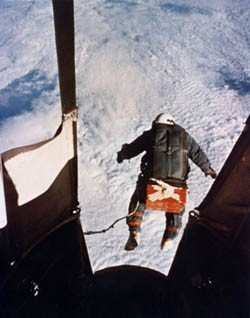
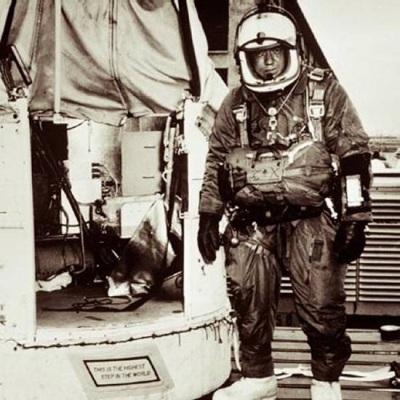
It was Kittinger, as part of the US Air Force Project Man High, who made the original “Long Lonely Leap” from 102,800 feet on August 16, 1960 from the Excelsior III balloon setting a record that stood until the Baumgartner jump.
That jump earned Kittinger the title of a ‘pre-astronaut’ as his research accomplished in the ManHigh and Excelsior projects were used by NASA and he is credited with saving many lives as one of the project’s goals, as was the case in the Red Bull mission, was the testing of life support, communications, and new pressure suit technologies for America’s coming space program.
Kittinger told those in attendance that systems developed from his research are still being used today, notably the small stabilization drogue parachute used in all aircraft escape systems. Joking with the audience on hand Kittinger began his remarks by saying, “It’s hard to be humble when you’re a fighter pilot.” He went on to praise the State of New Mexico and those who supported the Red Bull Stratos Project saying it was he who insisted on the jump being made in New Mexico because "the whole state of New Mexico is a drop zone. You can jump out of anything, anyplace in New Mexico and land safely.”
Kittinger said the key to his successful jumps and to the Stratos project was the support team that surrounded both he and Baumgartner. Seven stratospheric balloon flights (four by Kittinger, three by Baumgartner) have been made from the State of New Mexico, a singular distinction for the state.
Kittinger is a man of many notable achievements, among them; he was a test pilot, served 3 tours of duty in Viet Nam before being shot down and then surviving many months as a POW in the infamous ‘Hanoi Hilton.’ In 1984 he made the first successful solo crossing of the Atlantic by balloon.
Inducted into the Hall of Fame posthumously was John M. Bacon. He was a theologian, astronomer, balloonist, mathematician, and is credited as the first British aerial photographer having taken snapshots of the English countryside on his first balloon flight on August 20, 1888. The website www.mesasphere.com reports, “In 1903 the Rev. John M. Bacon invented the forerunner of the "Modern hot air balloon" in England. While coal gas was plentiful and cheap locally, expeditionary forces had severe logistical problems with either producing hydrogen in the field or transporting heavy compressed gas cylinders for inflating observation balloons.
Bacon conceived the concept of a military hot air observation balloon with available liquid petroleum vaporizing burners. He demonstrated the feasibility of the scheme by constructing a copper coiled “Roarer” burner with a pressurized fuel system and rigging it below a second hand cotton hot air balloon. His trials in the summer of 1903 were successful but he did not pursue it further in 1904 and died that Christmas.
(Images of Col. Joe Kittinger from file)



 Aero-News: Quote of the Day (12.09.25)


 See All