
NEAT Tests Megawatt-Scale Electric Aircraft Power Systems | Aero-News Network
Aero-News Network
RSS icon RSS feed
podcast icon MP3 podcast
Subscribe Aero-News e-mail Newsletter Subscribe

Airborne Unlimited -- Most Recent Daily Episodes

Episode Date

Airborne-Monday

Airborne-Tuesday

Airborne-Wednesday Airborne-Thursday

Airborne-Friday

Airborne On YouTube

Airborne-Unlimited-12.01.25

AirborneNextGen-
11.18.25

Airborne-Unlimited-11.19.25

Airborne-AffordableFlyers-11.20.25

AirborneUnlimited-11.21.25

LIVE MOSAIC Town Hall (Archived): www.airborne-live.net

Sat, Jun 01, 2019

NEAT Tests Megawatt-Scale Electric Aircraft Power Systems

NASA Electric Aircraft Testbed Will Work On Electric-Powered Airliners

As large airline companies compete to reduce emissions, fuel and noise, aircraft manufacturers are shifting more of their aircraft systems to electrical power. To help usher in the next revolution in aviation— hybrid electric and turboelectric aircraft – NASA is building and testing portions of a concept aircraft’s power systems with an eye toward the future.

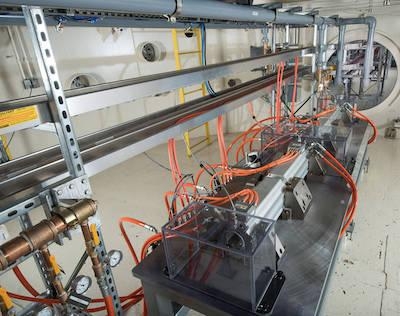
NASA Glenn has repurposed its Hypersonic Tunnel Facility to create the NASA Electric Aircraft Testbed (NEAT). Located at Plum Brook Station in Sandusky, Ohio, NEAT is a world-class, reconfigurable facility that can accommodate power systems for large passenger airplanes like a Boeing 737, with megawatts of power. This testbed, which recently conducted its first megawatt-scale test, takes advantage of the facility’s massive amounts of available power to carry out research and technology development of aircraft electrical powertrains – like the power system seen here.

“We can layout an entire electric powertrain, not including the engines, in NEAT and test all of the key electrical systems for an electrified aircraft,” says Dr. Rodger Dyson, principal investigator.

NEAT also includes a vacuum chamber, where this photo perspective was taken from, which can currently simulate altitudes of up to 40,000 feet to test high-voltage power electronics, electric motors, and controls. Within the year, NASA plans to increase the altitude capability to over 50,000 feet.

“NEAT can make a difference in aviation because it has the power and size to investigate the full power capabilities of the next generation of hybrid and turboelectric aircraft,” says Dyson.

(Image provided with NASA news release)

FMI: www.nasa.gov

Advertisement

More News

ANN's Daily Aero-Term (11.28.25): Unmanned Aircraft System (UAS)

Unmanned Aircraft System (UAS) An unmanned aircraft and its associated elements related to safe operations, which may include control stations (ground, ship, or air based), control>[...]

ANN's Daily Aero-Linx (11.28.25)

Aero Linx: Cactus Fly-In The Classic Airplane Association of Arizona, Inc. (CAAA) was incorporated in Arizona as a not for profit corporation on January 10, 2014. The CAAA roster i>[...]

Airborne 11.21.25: NTSB on UPS Accident, Shutdown Protections, Enstrom Update

Also: UFC Buys Tecnams, Emirates B777-9 Buy, Allegiant Pickets, F-22 And MQ-20 The NTSB's preliminary report on the UPS Flight 2976 crash has focused on the left engine pylon's sep>[...]

Airborne 11.26.25: Bonanza-Baron Fini, Archer v LA NIMBYs, Gogo Loses$$$

Also: Bell 505 on SAF, NYPA Gets Flak For BizAv 'Abuse', FAA Venezuela Caution, Horizon Update Textron Aviation has confirmed it will be ending production of the Beechcraft Bonanza>[...]

Airborne-NextGen 11.25.25: EHang Manned Flt, Army UAVs, Starship V3 Booster Boom

Also: FedEx SAF, Archer Midnight Powertrain Tech, Rocket Lab Record, Perseverance Rover Find EHang has logged a major milestone in the development of its pilotless air taxi, loggin>[...]

blog comments powered by Disqus



Advertisement

Advertisement

Podcasts

Advertisement

© 2007 - 2025 Web Development & Design by Pauli Systems, LC

