
College Students Design Futuristic Flying Rescue Vehicles For NASA Contest | Aero-News Network
Aero-News Network
RSS icon RSS feed
podcast icon MP3 podcast
Subscribe Aero-News e-mail Newsletter Subscribe

Airborne Unlimited -- Most Recent Daily Episodes

Episode Date

Airborne-Monday

Airborne-Tuesday

Airborne-Wednesday Airborne-Thursday

Airborne-Friday

Airborne On YouTube

Airborne-Unlimited-12.22.25

AirborneNextGen-
12.23.25

Airborne-Unlimited-12.10.25

Airborne-FltTraining-12.18.25

AirborneUnlimited-12.19.25

AFE 2025 LIVE MOSAIC Town Hall (Archived): www.airborne-live.net

Thu, Jun 24, 2010

College Students Design Futuristic Flying Rescue Vehicles For NASA Contest

Winning Concept Is An Amphibious, Tilt-Rotor Catamaran

A rotorcraft that resembles a catamaran has taken the top prize in a NASA aeronautics competition for college students to develop a multi-purpose aircraft.


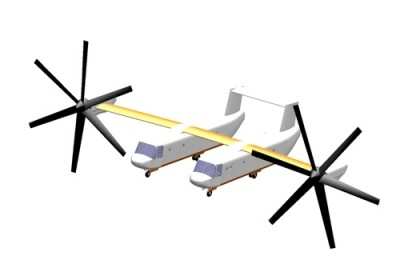
Virginia Tech Concept NASA Image

The entry by ten students at Virginia Tech in Blacksburg, VA, met the competition's challenge to design a civilian aircraft that could rescue up to 50 survivors in the event of a natural disaster, hover to help rescue missions, land on ground or water, travel 920 miles and cruise at speeds up to 345 miles an hour. The amphibious tilt-rotor vehicle also had to be able to fight fires by siphoning water into an internal tank, then dumping it after airborne.

NASA's Aeronautics Mission Directorate in Washington sponsored the competition through the Subsonic Rotary Wing Project in its Fundamental Aeronautics Program. More than 100 college students from the United States, India, the United Kingdom, Canada, Poland, China and Nigeria entered the contest in teams or as individuals.


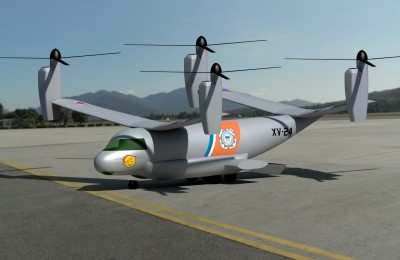
GA Tech Concept NASA Image

Susan Gorton, principal investigator of the Subsonic Rotary Wing Project, led the review panel. "The designs were creative, innovative and looked at many issues in detail," she said. "Reading the student papers highlighted how many bright young engineers are interested in the future of rotary wing vehicles. I certainly hope some of them decide to work with NASA as a career choice."

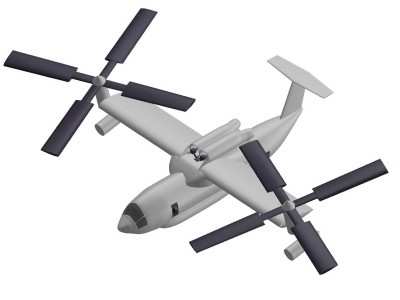
Ten Virginia Tech undergraduates came up with the winning design-- a twin-hulled vehicle with a large prop-rotor flanking each hull. A team of 10 graduate students from Georgia Tech in Atlanta and the University of Liverpool in England took second place, and 28 undergraduates from the University of Virginia in Charlottesville placed third.


University of Virginia Concept NASA Image

NASA sponsored the design contest to interest students in aeronautics and engineering careers. Each winning U.S. team received a cash award and an engraved trophy through a NASA education grant and cooperative agreement. Cash awards ranged from $5,000 for first place to $3,000 for third place. Five of the students from the top U.S. teams also won paid summer internships at NASA.

FMI: www.nasa.gov

Advertisement

More News

Classic Aero-TV: In Praise of Alabama’s Patriot Aircraft USA

From 2023 (YouTube Edition): "Ain’t Your Daddy’s Super Cub”—Don Wade Co-owned by Don and Ron Wade—the former of Don’s Dream Machines, a storied >[...]

NTSB Final Report: Cirrus Design Corp SR22

Pilot-Rated Passenger Reported That The Pilot Did Not Adequately “Round Out” The Landing Flare And The Airplane Bounced And Yawed To The Right Analysis: The pilot state>[...]

ANN's Daily Aero-Term (12.21.25): Dead Reckoning

Dead Reckoning Dead reckoning, as applied to flying, is the navigation of an airplane solely by means of computations based on airspeed, course, heading, wind direction, and speed,>[...]

ANN's Daily Aero-Linx (12.21.25)

Aero Linx: Lake Amphibian Club This website is created and sponsored by the Lake Amphibian Club, to help spread the word about these wonderful, versatile amphibians that can land j>[...]

Aero-News: Quote of the Day (12.21.25)

“I am deeply honored to be sworn in as NASA administrator. NASA’s mission is as imperative and urgent as ever — to push the boundaries of human exploration, ignit>[...]

blog comments powered by Disqus



Advertisement

Advertisement

Podcasts

Advertisement

© 2007 - 2025 Web Development & Design by Pauli Systems, LC

