Mon, Jun 12, 2017
Have All Conceptualized Solutions For Parts Of The UAS 'Puzzle'
Three teams of NASA researchers who have dreamed up potential solutions for pieces of the Unmanned Aircraft Systems (UAS) puzzle have received the nod to officially begin formal feasibility studies of their concepts.
The trio of investigations are part of NASA’s Convergent Aeronautics Solutions (CAS) project and are expected to take between 24 and to 30 months to complete.
“Our idea is to invest a very modest amount of time and money into new technologies that are ambitious and potentially transformative,” said Richard Barhydt, NASA’s acting director of the Transformative Aeronautics Concepts Program (TACP). “They may or may not work, but we won’t know unless we try.”
The studies will explore whether and how it might be possible to:
- Build a path toward safe inclusion and certification of autonomous systems in aviation. Autonomous systems, such as self-driving cars and future UAS, rely on learning algorithms that adapt to new goals and environments. The idea is to develop autonomy-enabling algorithms that lay a foundation for establishing justifiable confidence in machine decisions and, ultimately, lead to certification of autonomous systems.
- Develop new methods and technologies for a remotely-piloted drone to make sure it’s “fit to fly” before every single flight. The idea is to verify the aircraft is structurally and mechanically sound, and that all its onboard systems have not been damaged or hacked in some way. If it’s not sound, the aircraft will ground itself.
- Use quantum computing and communication technology to build a secure and jam-free network capable of accommodating hundreds of thousands of drones flying each day. Because of the manner in which data is organized and processed, quantum computing enables certain computations and communications to be done much more efficiently than a regular computer. For example, quantum computers may be able to solve certain problems in a few days that would take millions of years on the average computer.
The three studies were selected by a team of NASA aeronautics managers, led by recently retired TACP Director Doug Rohn, who made their decisions after hearing proposals offered by the principal investigators.
To be considered, research teams had to form on their own, represent multidisciplinary talents, and have members from more than one of NASA's aeronautics centers in Virginia, California and Ohio.
The three selected proposals join five that were selected in 2016 and six that were selected in 2015.
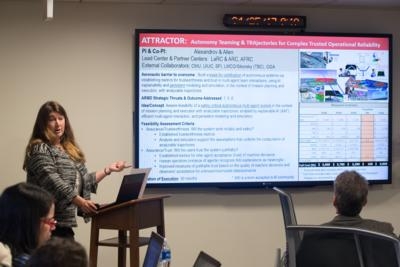
(Image provided with NASA news release. Principal Investigator Natalia Alexandrov makes the pitch to a group of NASA aeronautics managers for her team’s study, ATTRACTOR, which will explore how to embed reliability into algorithms that are used over time to inform autonomous systems in aviation)
More News
Decision Altitude (DA) A specified altitude (mean sea level (MSL)) on an instrument approach procedure (ILS, GLS, vertically guided RNAV) at which the pilot must decide whether to >[...]
Aero Linx: T-34 Association, Inc. The T-34 Association was formed in July 1975 so that individuals purchasing then military surplus T-34As had an organization which would provide s>[...]
As He Released The Brakes To Begin Taxiing, The Brake Pedals Went To The Floor With No Braking Action Analysis: The pilot reported that during engine start up, he applied the brake>[...]
“Legislation like the Mental Health in Aviation Act is still imperative to hold the FAA accountable for the changes they clearly acknowledge need to be made... We cannot wait>[...]
Also: IAE Acquires Diamond Trainers, Army Drones, FedEx Pilots Warning, DA62 MPP To Dresden Tech Uni The danger to the flight training industry and our future pilots is clear. Dona>[...]



 ANN's Daily Aero-Term (12.08.25): Decision Altitude (DA)


 See All