

NTSB Releases Final Report on October 2022 Aeronca 7AC Accident | Aero-News Network
Aero-News Network
RSS icon RSS feed
podcast icon MP3 podcast
Subscribe Aero-News e-mail Newsletter Subscribe

Airborne Unlimited -- Most Recent Daily Episodes

Episode Date

Airborne-Monday

Airborne-Tuesday

Airborne-Wednesday Airborne-Thursday

Airborne-Friday

Airborne On YouTube

Airborne-Unlimited-11.24.25

AirborneNextGen-
11.18.25

Airborne-Unlimited-11.19.25

Airborne-AffordableFlyers-11.20.25

AirborneUnlimited-11.21.25

LIVE MOSAIC Town Hall (Archived): www.airborne-live.net

Sat, May 13, 2023

NTSB Releases Final Report on October 2022 Aeronca 7AC Accident

Reverse Engineering

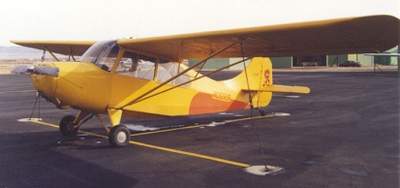
The NTSB has released its final report on a 02 October 2022 accident in which the pilot of a 1946 Aeronca 7AC, registration N3005E, was seriously injured and the airplane substantially damaged following a mishap since attributed to faulty aircraft maintenance.

The Aeronca 7AC had been in maintenance undergoing empennage repairs. On the first flight subsequent completion of the aforementioned work—following a preflight inspection and engine run-up—the 69-year-old instrument-rated Commercial pilot taxied the aircraft to the departure end of Murray, Kentucky’s Kyle-Oakley Field Airport’s (CEY) Runway 05. During the takeoff roll, as the pilot applied forward stick pressure to raise the Aeronca’s tail, the airplane “shot straight up, stalled, then descended nose-first onto the runway.”

In addition to substantial fuselage damage, post-accident examination of the downed Aeronca revealed the aircraft’s elevator control cables had been incorrectly installed—such that the machine's elevator articulated in the direction opposite that commanded by the pilot.

The National Transportation Safety Board determined the accident’s probable cause(s) to be:

The incorrect (reverse) rigging of the aircraft’s elevator cables by maintenance personnel; maintenance personnels’ failure to verify subject cables were correctly rigged during post-maintenance checks; and the pilot's failure to identify reverse elevator articulation during his preflight check of the aircraft.

The flight was conducted in Class “E” airspace under Part 91 of the Federal Aviation Regulations. At the time of the accident, Day Visual Meteorological Conditions (VMC) prevailed. Weather reports cited Ceiling and Visibility Unlimited (CAVU) with winds from 350° at 13-knots and gusts of 20-knots.

The instrument rated, non-professional Commercial pilot was qualified in single-and-multi-engine land airplanes, single-engine sea-planes, and gliders. He held a Class III FAA medical certificate without waivers or limitations. At the time of the accident, he’d logged 2,900 total aircraft hours; 2,740 PIC hours, and 125 hours in the Aeronca 7AC. The pilot had successfully completed a flight-review on 23 October 2021.

Parties interested in learning more about the occurrence may reference NTSB Accident Number: ERA23LA002.

FMI: www.ntsb.gov

Advertisement

More News

Classic Aero-TV: Extra; the Airplane, the Man, and His Grand DeLand Plan

From 2023 (YouTube Edition): Germany’s Best by Way of Florida Established in 1980 by German aerobatic pilot Walter Extra as a means by which to design and develop his own air>[...]

ANN FAQ: Follow Us On Instagram!

Get The Latest in Aviation News NOW on Instagram Are you on Instagram yet? It's been around for a few years, quietly picking up traction mostly thanks to everybody's new obsession >[...]

Aero-News: Quote of the Day (11.27.25)

“Achieving PMA for the S-1200 Series magnetos is another step in expanding our commitment to providing the aviation community with the most trusted and durable ‘firewal>[...]

ANN's Daily Aero-Term (11.27.25): Ultralight Vehicle

Ultralight Vehicle A single-occupant aeronautical vehicle operated for sport or recreational purposes which does not require FAA registration, an airworthiness certificate, or pilo>[...]

ANN's Daily Aero-Linx (11.27.25)

Aero Linx: The de Havilland Moth Club Ltd The de Havilland Moth Club evolved from a belief that an association of owners and operators of Moth aeroplanes should be formed to create>[...]

blog comments powered by Disqus



Advertisement

Advertisement

Podcasts

Advertisement

© 2007 - 2025 Web Development & Design by Pauli Systems, LC

