
USAF Report Released On Sheppard T-38 Accident | Aero-News Network
Aero-News Network
RSS icon RSS feed
podcast icon MP3 podcast
Subscribe Aero-News e-mail Newsletter Subscribe

Airborne Unlimited -- Most Recent Daily Episodes

Episode Date

Airborne-Monday

Airborne-Tuesday

Airborne-Wednesday Airborne-Thursday

Airborne-Friday

Airborne On YouTube

Airborne-Unlimited-12.08.25

AirborneNextGen-
12.09.25

Airborne-Unlimited-12.10.25

Airborne-AffordableFlyers-12.11.25

AirborneUnlimited-12.12.25

AFE 2025 LIVE MOSAIC Town Hall (Archived): www.airborne-live.net

Mon, Aug 11, 2008

USAF Report Released On Sheppard T-38 Accident

Air Force officials have completed their investigation of the May 1 T-38C Talon accident at Sheppard Air Force Base, Texas, which resulted in the deaths of two pilots and destroyed the airplane.

Maj. Brad T. Funk, a 90th Flying Training Squadron instructor pilot, and 2nd Lt. Alec F. Littler, a student pilot assigned to the 80th Operations Support Squadron, were flying a training mission simulating a single engine landing approach with a full fuel load with the intent to touch down on the Sheppard AFB runway and then take off again.

The T-38 landed short of the runway, causing debris from the overrun surface to enter the right engine and causing it to seize. Major Funk took command of the aircraft upon the short landing and advanced the left engine throttle to maximum power, and as the aircraft was climbing from the ground retracted the landing gear and the flaps. With the flaps retracted, the T-38 had insufficient power and airspeed to sustain lift and stalled.

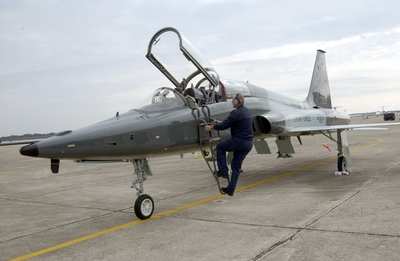
With their T-38 (file photo, below) in a fully developed stall 25 to 40 feet above the ground, the crew ejected from the aircraft. Their near simultaneous ejection caused contact between the two ejection seats and disrupted the direction and sequence of the ejection. Both were killed on impact with the ground.

The accident investigation board determined the cause of the mishap was pilot error based on the instructor pilot's failure to execute critical emergency procedures upon right engine failure. Specifically, the decision to retract the flaps rather than leaving them extended resulted in insufficient lift to sustain flight.

There were no other casualties from this mishap and other than the aircraft, there was no property damage.

Col. Richard Haddad from the 23rd Air Force at Hurlburt Field, Fla., headed the accident investigation board.

FMI: www.af.mil

Advertisement

More News

Aero-News: Quote of the Day (12.09.25)

“We respectfully call on the City of Mesa to: 1. Withdraw the landing fee proposal immediately 2. Engage with the aviation community before making decisions that impact safet>[...]

ANN's Daily Aero-Term (12.09.25): High Speed Taxiway

High Speed Taxiway A long radius taxiway designed and provided with lighting or marking to define the path of aircraft, traveling at high speed (up to 60 knots), from the runway ce>[...]

ANN's Daily Aero-Linx (12.09.25)

Aero Linx: International Federation of Airworthiness (IFA) IFA uniquely combines together all those with responsibility for policies, principles and practices concerned with the co>[...]

NTSB Final Report: Diamond Aircraft Ind Inc DA20C1 (A1); Robinson Helicopter R44

Controller’s Expectation That VW02 Would Have Departed Sooner Led To An Inadequate Scan And Loss Of Situational Awareness Analysis: A Robinson R-44 helicopter N744AF, VW02 (V>[...]

ANN FAQ: Q&A 101

A Few Questions AND Answers To Help You Get MORE Out of ANN! 1) I forgot my password. How do I find it? 1) Easy... click here and give us your e-mail address--we'll send it to you >[...]

blog comments powered by Disqus



Advertisement

Advertisement

Podcasts

Advertisement

© 2007 - 2025 Web Development & Design by Pauli Systems, LC

