Space PlasmA Diagnostic suitE (SPADE) Experiment Launched To The Station May 4
Developed by the U.S. Naval Research Laboratory Plasma Physics Division, in conjunction with the Spacecraft Engineering Department, the Space PlasmA Diagnostic suitE (SPADE) experiment launched from Kennedy Space Center in Florida to the International Space Station onboard the SpaceX Dragon resupply mission (CRS-17), May 4.
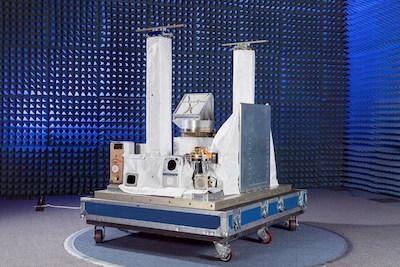
Integrated onto the Space Test Program-Houston 6 (STP-H6) pallet, SPADE is designed to monitor background space plasma conditions on-orbit the International Space Station and provide early warning of the onset of hazardous levels of spacecraft charging.
The space environment is filled with a collection of electrically charged particles, plasma, and properties that depend on variable solar conditions. Satellite operations in space require continuous monitored plasma conditions and the results it has on spacecraft.
Dr. Erik Tejero, a plasma physicist at NRL's Plasma Physics Division, compared the effects of spacecraft charging to the electrical charge build-up that occurs when walking across a carpet. "While the shock you get from your carpet isn't dangerous, a sudden discharge in space can pose a serious threat or costly damage to sensitive satellite electronics," Tejero said.
At present, there are no simple, dedicated sensors to monitor spacecraft charging.
The SPADE experiment is designed to demonstrate the instrument's response to slight changes in the plasma sheath. This is often referred to as the Debye sheath formed around a charged object that provides a unique NRL-developed method for early detection. A component of the SPADE suite consists of an active antenna used to excite the local plasma and a passive antenna that observes the excitation. The active probe is swept across a range of frequencies and DC voltage biases to determine the plasma impedance spectrum. The impedance measurement then assists to determine the plasma's physical properties, such as density, plasma potential and electron temperature. It provides data to indicate the charging level of the International Space Station relative to the local plasma.
"This is an indication of the plasma's 'resistance' to current flow at each setting," Tejero said. "Laboratory investigations have illustrated that the NRL impedance probe can yield useful data in operational regimes where other techniques are less feasible," he said. "This opens many new possibilities for measurements in industrial processed plasmas and in atmospheric pressure discharge experiments."
The year-long mission tests SPADE's ability to detect hazardous station charging events and provide long-term records of space weather conditions.
The U.S. Naval Research Laboratory provides the advanced scientific capabilities required to bolster our country's position of global naval leadership. With more than 2,500 personnel scientists, engineers and support staff, it has served the U.S. Navy and the nation for nearly 100 years, advancing research further than you can imagine. For more information, visit the NRL website and join the conversation on Twitter, Facebook, and YouTube.
(Image provided with NRL news release)



 ANN's Daily Aero-Term (12.08.25): Decision Altitude (DA)


 See All