
NASA Tests Orion Scale Models In Water | Aero-News Network
Aero-News Network
RSS icon RSS feed
podcast icon MP3 podcast
Subscribe Aero-News e-mail Newsletter Subscribe

Airborne Unlimited -- Most Recent Daily Episodes

Episode Date

Airborne-Monday

Airborne-Tuesday

Airborne-Wednesday Airborne-Thursday

Airborne-Friday

Airborne On YouTube

Airborne-Unlimited-12.08.25

AirborneNextGen-
12.09.25

Airborne-Unlimited-12.10.25

Airborne-AffordableFlyers-12.11.25

AirborneUnlimited-12.12.25

AFE 2025 LIVE MOSAIC Town Hall (Archived): www.airborne-live.net

Thu, Sep 11, 2008

NASA Tests Orion Scale Models In Water

Full Scale Tests Coming In January

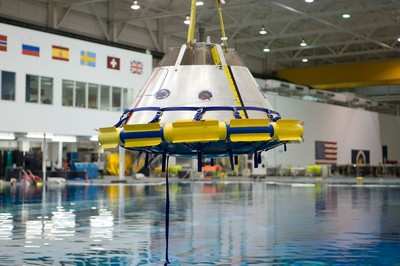
Scale models of the Orion crew exploration vehicle recently were tested at NASA’s Neutral Buoyancy Laboratory, or NBL, at NASA's Johnson Space Center in Houston and at a wave tank at Texas A&M University in College Station.

NASA conducted a series of buoyancy and flotation characteristics tests in August, using the NBL and a 1/4-scale model of the Orion crew capsule. The model was lowered into the NBL's 6.2-million-gallon pool and was floated in a series of positions. This testing will allow the engineers and the NBL team to develop their full-scale crew training mock-up that will be used for mission training and for creating the crew safety procedures for water-based landings of the Orion crew capsule.

The team also performed a series of tests to validate a new seal design and updated wireless communications. Engineers also evaluated a prototype floatation collar for the spacecraft, which was provided by NASA's Kennedy Space Center in Florida.

"It is rewarding to see an actual scale model of Orion finally being tested in the water," said Alan Rhodes, a NASA engineer who was observing the testing. "The NBL is a one-of-a-kind testing facility for NASA, and the team helped us gather a tremendous amount of critical data that we will use to refine the design of Orion."

A smaller scale model of the Orion crew capsule also was tested at a wave tank at Texas A&M University. The goal of the test was to determine how the spacecraft reacts to strong waves while it floats in the water. Engineers simulated gale force winds and large waves to ensure the spacecraft would remain upright.

The next step for the team will be to partner with a team of naval architects from the United States Navy to conduct a series of flotation characteristics and towing tests to help further understand how the Orion crew capsule will act in different sea states and to help generate recovery procedures. The next round of testing will be held in October at the Naval Surface Warfare Center in Carderock, Md., and at the Aberdeen Proving Ground in Aberdeen, MD.

Along with the scaled testing, NASA and the United States Navy began fabrication of a full-scale test article that will allow search and rescue divers from the Human Space Flight Support team at the Kennedy Space Center to begin working with an Orion mock-up in the water. These tests will allow the team to review current recovery procedures and to understand how changing sea states will affect the overall recovery operation.

Full-scale testing will take place off the coast of Florida, near the Kennedy Space Center, in January 2009.

FMI: www.nasa.gov/constellation

Advertisement

More News

Aero-News: Quote of the Day (12.09.25)

“We respectfully call on the City of Mesa to: 1. Withdraw the landing fee proposal immediately 2. Engage with the aviation community before making decisions that impact safet>[...]

ANN's Daily Aero-Term (12.09.25): High Speed Taxiway

High Speed Taxiway A long radius taxiway designed and provided with lighting or marking to define the path of aircraft, traveling at high speed (up to 60 knots), from the runway ce>[...]

ANN's Daily Aero-Linx (12.09.25)

Aero Linx: International Federation of Airworthiness (IFA) IFA uniquely combines together all those with responsibility for policies, principles and practices concerned with the co>[...]

NTSB Final Report: Diamond Aircraft Ind Inc DA20C1 (A1); Robinson Helicopter R44

Controller’s Expectation That VW02 Would Have Departed Sooner Led To An Inadequate Scan And Loss Of Situational Awareness Analysis: A Robinson R-44 helicopter N744AF, VW02 (V>[...]

ANN FAQ: Q&A 101

A Few Questions AND Answers To Help You Get MORE Out of ANN! 1) I forgot my password. How do I find it? 1) Easy... click here and give us your e-mail address--we'll send it to you >[...]

blog comments powered by Disqus



Advertisement

Advertisement

Podcasts

Advertisement

© 2007 - 2025 Web Development & Design by Pauli Systems, LC

