Blue Origin’s New Glenn Rocket Seems To Boast Several On SpaceX Features...
New Glenn successfully completed an integrated launch vehicle hotfire test over the holiday week, the final major milestone on our road to first flight. NG-1 will carry a Blue Ring Pathfinder as its first manifested payload and will launch from Launch Complex 36 in Cape Canaveral, FL.
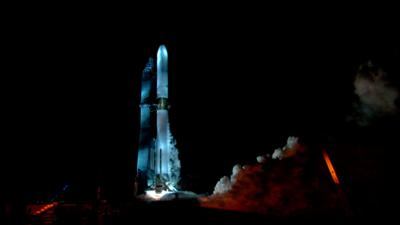
The seven-engine hotfire lasted 24 seconds and marked the first time they operated the entire flight vehicle as an integrated system. The multi-day test campaign leading up to the hotfire included numerous inert functional and tanking tests. The integrated launch vehicle included the first and second stages of the NG-1 flight vehicle, and a payload test article comprised of manufacturing test demonstrator fairings, a high-capacity fixed adapter flight unit, and a 45,000 lb. payload mass simulator.
One of the primary goals of the test campaign was to demonstrate day-of-launch operations in their NG-1 test configuration. Additionally, the team conducted several tests to validate vehicle and ground systems in the fully integrated, on-pad configuration. This data will be utilized to finalize day-of-launch timelines, confirm expected performance, and correlate our models to real-world test data.
The tanking test included a full run-through of the terminal count sequence, testing the hand-off authority to and from the flight computer, and collecting fluid validation data. The first stage (GS1) tanks were filled and pressed with liquefied natural gas (LNG) and liquid oxygen (LOX), and the second stage (GS2) with liquid hydrogen and liquid oxygen–both to representative NG-1 set points.
The formal NG-1 Wet Dress Rehearsal demonstrated the final launch procedures leading into the hotfire engine run. All seven engines performed nominally, firing for 24 seconds, including at 100% thrust for 13 seconds. The test also demonstrated New Glenn’s autogenous pressurization system, which self-generates gases to pressurize GS1’s propellant tanks.
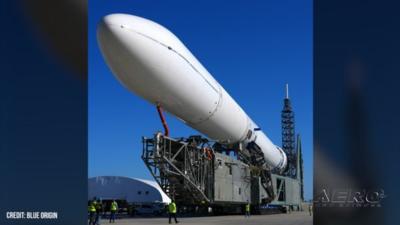
This test campaign captured a number of firsts for the New Glenn launch system, including the first seven-engine operations, the first integrated GS1-GS2 tanking demonstration, the first LNG/LOX fill for GS1, as well as first chilled helium operations for GS2.
The campaign met all objectives and marks the final major test prior to launch.
Blue Origin reports that it has several New Glenn vehicles in production and a full customer manifest. Customers include NASA, Amazon’s Project Kuiper, AST SpaceMobile, several telecommunications providers, and a mix of U.S. government customers. Blue Origin is certifying New Glenn with the U.S. Space Force for the National Security Space Launch (NSSL) program to meet emerging national security objectives.

The New Glenn vehicle stands more than 320 feet high in launch configuration and features a seven-meter payload fairing, enabling twice the volume of standard five-meter class commercial launch systems. Its reusable first stage aims for a minimum of 25 missions and will land on Jacklyn, a sea-based platform located several hundred miles downrange -- quite similar to the procedures pioneered by SpaceX... Reusability reportedly is integral to radically reducing Blue origin's cost-per-launch.
The vehicle is powered by seven of Blue Origin’s BE-4 engines -- which they call the most powerful liquefied natural gas (LNG)-fueled, oxygen-rich staged combustion engine ever flown. LNG is cleaner-burning and higher-performing than kerosene-based fuels, and the seven BE-4s generate over 3.8 million lbf of thrust. The vehicle’s second stage is powered by two BE-3Us, liquid oxygen (LOX)/liquid hydrogen (LH2) engines designed to together yield over 320,000 lbf of vacuum thrust.



 Classic Aero-TV: VerdeGo Debuts VH-3 Hybrid-Electric Powerplant


 See All