Sat, Jun 19, 2021
Astro's Still Need To Install Electrical Cables And Drive The Final Two Bolts To Enable The Solar Array To Unfurl
NASA astronaut Shane Kimbrough and ESA (European Space Agency) astronaut Thomas Pesquet concluded their spacewalk at 3:26 p.m. EDT, Wednesday, after 7 hours and 15 minutes. In the seventh spacewalk of the year outside the International Space Station, the two astronauts installed a new ISS Roll-Out Solar Array (iROSA) into its mounting bracket on the far end of the left (port) side of the station’s backbone truss structure (P6).
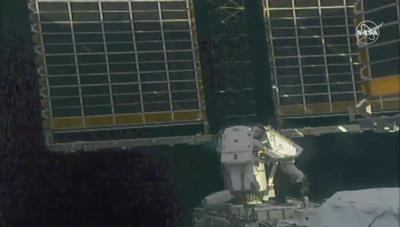
Kimbrough and Pesquet successfully removed the array from its position in the flight support equipment and maneuvered it into position on the mast canister at the 2B power channel.
Before the new array can be deployed and begin providing power to the orbiting laboratory, spacewalkers will need to install the electrical cables and drive the final two bolts to enable the solar array to unfurl its fully deployed position. Pesquet and Kimbrough are scheduled for another spacewalk coming up on Sunday, June 20 to continue the installation of new solar arrays.
NASA is augmenting six of the eight existing power channels of the space station with new solar arrays to ensure a sufficient power supply is maintained for NASA’s exploration technology demonstrations for Artemis and beyond as well as utilization and commercialization.
This was the seventh spacewalk for Kimbrough, the third for Pesquet, and the third they conducted together. Kimbrough has now spent a total of 46 hours and 15 minutes spacewalking, and Pesquet’s total spacewalking time is 19 hours and 47 minutes.
Space station crew members have conducted 239 spacewalks in support of assembly and maintenance of the orbiting laboratory. Spacewalkers have now spent a total of 62 days, 18 hours, and 28 minutes working outside the station.
In November 2020, the International Space Station surpassed its 20-year milestone of continuous human presence, providing opportunities for unique research and technological demonstrations that help prepare for long-duration missions to the Moon and Mars and also improve life on Earth. In that time, 244 people from 19 countries have visited the orbiting laboratory that has hosted nearly 3,000 research investigations from researchers in 108 countries and areas.
More News
“These new aircraft strengthen our ability to respond quickly, train effectively and support communities nationwide. Textron Aviation has been a steadfast supporter in helpin>[...]
From 2011 (YouTube Edition): Rugged, Legendary, STOL Twin Makes A Comeback The de Havilland Twin Otter is an airplane with a long history, and it gained a reputation as a workhorse>[...]
A Wind Gust Lifted The Right Wing And The Airplane Turned To The Left Analysis: The pilot was departing from a 2,395-ft-long by 50-ft-wide turf runway. The pilot reported that afte>[...]
Have A Story That NEEDS To Be Featured On Aero-News? Here’s How To Submit A Story To Our Team Some of the greatest new stories ANN has ever covered have been submitted by our>[...]
Braking Action Advisories When tower controllers receive runway braking action reports which include the terms “medium," “poor," or “nil," or whenever weather con>[...]



 Aero-News: Quote of the Day (12.18.25)


 See All