
LDSD Flight Test Scrapped Due To Weather | Aero-News Network
Aero-News Network
RSS icon RSS feed
podcast icon MP3 podcast
Subscribe Aero-News e-mail Newsletter Subscribe

Airborne Unlimited -- Most Recent Daily Episodes

Episode Date

Airborne-Monday

Airborne-Tuesday

Airborne-Wednesday Airborne-Thursday

Airborne-Friday

Airborne On YouTube

Airborne-Unlimited-12.08.25

AirborneNextGen-
12.09.25

Airborne-Unlimited-12.10.25

Airborne-AffordableFlyers-12.11.25

AirborneUnlimited-12.12.25

AFE 2025 LIVE MOSAIC Town Hall (Archived): www.airborne-live.net

Sat, Jun 14, 2014

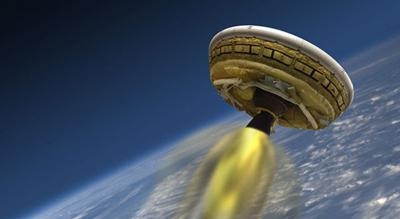
LDSD Flight Test Scrapped Due To Weather

NASA's 'Flying Saucer' Grounded Because Of Winds Aloft

NASA did not conduct the flight test of the agency's Low-Density Supersonic Decelerator (LDSD) from the U.S. Navy's Pacific Missile Range in Kauai, Hawaii, during its designated launch period. The project's reserved range time at the range will expire Saturday, June 14, with NASA unable to fly the test because of continuing unfavorable weather conditions.

Mark Adler, the Low Density Supersonic Decelerator project manager and Ian Clark, principal investigator on the project, both from NASA's Jet Propulsion Laboratory in Pasadena, California, participated in a media teleconference this morning and addressed questions on the project.

"There were six total opportunities to test the vehicle, and the delay of all six opportunities was caused by weather," said Adler. "We needed the mid-level winds between 15,000 and 60,000 feet to take the balloon away from the island. While there were a few days that were very close, none of the days had the proper wind conditions."

The team had researched for more than two years wind conditions and locations around the world that would be conducive to the test. Kauai was selected because research showed that this area had the proper wind conditions to carry the balloon away from populated areas and where it needed to go over the ocean in order to launch the test vehicle. Recent weather conditions have been unexpected and have caused unacceptable wind conditions to launch the balloon.

NASA continues to look at options for a future launch window. The team is working with the Pacific Missile Range Facility and looking at weather conditions predicted for later in the month when another launch window could be possible.

"Our team has been working on this project for several years, and we have been so focused," said Clark. "We came here to do our job and get this vehicle off the ground, but unfortunately weather didn't allow us to do this. We are very optimistic and are hoping to test the vehicle at the end of the month."

(Image provided by NASA)

FMI: www.nasa.gov

Advertisement

More News

Aero-News: Quote of the Day (12.11.25)

"The owners envisioned something modern and distinctive, yet deeply meaningful. We collaborated closely to refine the flag design so it complemented the aircraft’s contours w>[...]

ANN's Daily Aero-Term (12.11.25): Nonradar Arrival

Nonradar Arrival An aircraft arriving at an airport without radar service or at an airport served by a radar facility and radar contact has not been established or has been termina>[...]

Classic Aero-TV: David Uhl and the Lofty Art of Aircraft Portraiture

From 2022 (YouTube Edition): Still Life with Verve David Uhl was born into a family of engineers and artists—a backdrop conducive to his gleaning a keen appreciation for the >[...]

Airborne-NextGen 12.09.25: Amazon Crash, China Rocket Accident, UAV Black Hawk

Also: Electra Goes Military, Miami Air Taxi, Hypersonics Lab, MagniX HeliStrom Amazon’s Prime Air drones are back in the spotlight after one of its newest MK30 delivery drone>[...]

Airborne 12.05.25: Thunderbird Ejects, Lost Air india 737, Dynon Update

Also: Trailblazing Aviator Betty Stewart, Wind Farm Scrutiny, Chatham Ban Overturned, Airbus Shares Dive A Thunderbird pilot, ID'ed alternately as Thunderbird 5 or Thunderbird 6, (>[...]

blog comments powered by Disqus



Advertisement

Advertisement

Podcasts

Advertisement

© 2007 - 2025 Web Development & Design by Pauli Systems, LC

