Tue, Oct 11, 2016
New International Agreement Covers Armed UAVs
A joint declaration signed by 44 nations overseeing the sale of armed UAVs may favor non-U.S. companies over American manufacturers.
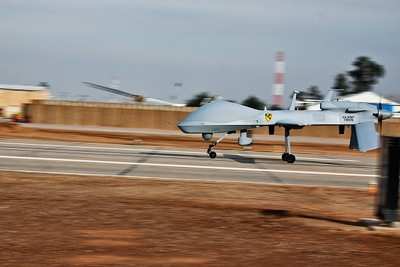
"Soft language" in the joint declaration could give foreign companies an edge if the language in the document contains standards that are lower than U.S. standards, according to a report from the Washington Examiner. The agreement requires a commitment to "responsible export" of armed UAVs and an ongoing conversation about the standards for drone sales and the use of those aircraft including drone strikes. Those must be conducted in accordance with "international law".
A State Department fact sheet indicates that further discussions about the specifics of the proposal will be conducted in the spring.
The Aerospace Industries Association (AIA) said in a statement that it is supportive of U.S. government efforts to promote international adoption of the Joint Declaration for the Export and Subsequent Use of Armed or Strike-Enabled Unmanned Aerial Vehicles (UAVs). "If our allies and security cooperation partners understand clearly and follow consistently the principles embedded in the Declaration, industry expects more efficient review and approval of U.S. exports of these systems. Further, the international adoption of these guidelines for armed and strike-enabled UAVs should also expedite the approval process for unarmed UAV exports for military end use, such as intelligence, surveillance and reconnaissance, as well as civilian and commercial use," said Vice President for International Affairs at the Aerospace Industries Association Remy Nathan.
"However, if other countries’ UAV systems predominate in the global market, and U.S. companies continue to lose market share to their foreign competitors, the United States could lose the leverage necessary to ensure that the Joint Declaration principles become the norm. Therefore, in addition to diplomatic efforts to promote the Joint Declaration, we also call on the U.S. government to make the interagency review and approval process for these exports more transparent, predictable and efficient to ensure that American UAV systems – and American principles on their export and subsequent use – will be the global standard," Nathan said.
In an editorial appearing in Defense News, Rachel Stohl, a senior associate at the Stimson Center, said that the restrictions in the joint declaration are "less robust" than those already in place for U.S. manufacturers. Those more restrictive policies could have a detrimental effect on U.S. businesses, she said.
(Image from file)
More News
“We respectfully call on the City of Mesa to: 1. Withdraw the landing fee proposal immediately 2. Engage with the aviation community before making decisions that impact safet>[...]
High Speed Taxiway A long radius taxiway designed and provided with lighting or marking to define the path of aircraft, traveling at high speed (up to 60 knots), from the runway ce>[...]
Aero Linx: International Federation of Airworthiness (IFA) IFA uniquely combines together all those with responsibility for policies, principles and practices concerned with the co>[...]
Controller’s Expectation That VW02 Would Have Departed Sooner Led To An Inadequate Scan And Loss Of Situational Awareness Analysis: A Robinson R-44 helicopter N744AF, VW02 (V>[...]
A Few Questions AND Answers To Help You Get MORE Out of ANN! 1) I forgot my password. How do I find it? 1) Easy... click here and give us your e-mail address--we'll send it to you >[...]



 Aero-News: Quote of the Day (12.09.25)


 See All