

Direct> From NASA: Shuttle Report | Aero-News Network
Aero-News Network
RSS icon RSS feed
podcast icon MP3 podcast
Subscribe Aero-News e-mail Newsletter Subscribe

Airborne Unlimited -- Most Recent Daily Episodes

Episode Date

Airborne-Monday

Airborne-Tuesday

Airborne-Wednesday Airborne-Thursday

Airborne-Friday

Airborne On YouTube

Airborne-SpecialEpisode-12.15.25

AirborneNextGen-
12.16.25

Airborne-Unlimited-12.10.25

Airborne-AffordableFlyers-12.11.25

AirborneUnlimited-12.12.25

AFE 2025 LIVE MOSAIC Town Hall (Archived): www.airborne-live.net

Wed, Jan 29, 2003

Direct> From NASA: Shuttle Report

STS-107 Report #13; Monday, January 27, 2003 -- 5:30 P.M. CST

Some experiments have run their course aboard the Space Shuttle Columbia, but there is more in store as STS-107 science continues around the clock in the Spacehab Research Double Module.

The Structures of Flame Balls experiment, looking at ways of improving engine combustion efficiency, was shut down after a total of 39 tests using 15 different fuel mixtures. A total of 55 flame balls were ignited, including the weakest and leanest flames ever burned. The longest-lived flame burned in space for 81 minutes, part of a total burn time for all flames of 6 1 /4 hours. Oscillating (shrinking and growing) flame balls, which had been predicted theoretically, were observed for the first time.

The Mechanics of Granular Materials test, looking for ways to better understand and deal with soil movement associated with earthquakes, completed its 10th and final run. The Microbial Physiology Flight Experiment expended its eighth and final set of samples looking at yeast and bacteria growth in microgravity. The Canadian-developed Osteoporosis in Orbit also completed its operations.

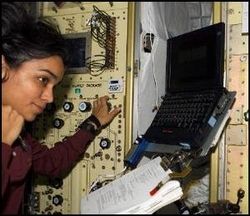
The Red team, or day shift – Commander Rick Husband, Mission Specialists Kalpana Chawla and Laurel Clark and Israel Space Agency Payload Specialist Ilan Ramon – took time out from microgravity experimentation about 11:30 a.m. CST to chat with the other three spacefarers on orbit – Commander Ken Bowersox, NASA ISS Science Officer Don Pettit and Flight Engineer Nikolai Budarin. At the time, the space station was some 240 miles above Southern Russia while the shuttle was over northern Brazil...

FMI: www.spaceflight.nasa.gov

Advertisement

More News

ANN's Daily Aero-Term (12.19.25): Ultrahigh Frequency (UHF)

Ultrahigh Frequency (UHF) The frequency band between 300 and 3,000 MHz. The bank of radio frequencies used for military air/ground voice communications. In some instances this may >[...]

NTSB Prelim: Cirrus Design Corp SR22T

During The 7 Second Descent, There Was Another TAWS Alert At Which Time The Engine Remained At Full Power On October 24, 2025 at 2115 mountain daylight time, a Cirrus SR22T, N740TS>[...]

Classic Aero-TV: The Red Tail Project--Carrying the Torch of the Tuskegee Airmen

From 2009 (YouTube Edition): Educational Organization Aims to Inspire by Sharing Tuskegee Story Founding leader Don Hinz summarized the Red Tail Project’s mission in simple, >[...]

Aero-News: Quote of the Day (12.19.25)

“This feels like an important step since space travel for people with disabilities is still in its very early days... I’m so thankful and hope it inspires a change in m>[...]

Airborne 12.17.25: Skydiver Hooks Tail, Cooper Rotax Mount, NTSB v NDAA

Also: New Katanas, Kern County FD Training, IndiGo’s Botched Roster, MGen. Leavitt Named ERAU Dean The Australian Transportation Safety Bureau (ATSB) has wrapped up its inves>[...]

blog comments powered by Disqus



Advertisement

Advertisement

Podcasts

Advertisement

© 2007 - 2025 Web Development & Design by Pauli Systems, LC

