

Hydrogen-Powered Aircraft To Attempt Non-Stop Global Flight | Aero-News Network
Aero-News Network
RSS icon RSS feed
podcast icon MP3 podcast
Subscribe Aero-News e-mail Newsletter Subscribe

Airborne Unlimited -- Most Recent Daily Episodes

Episode Date

Airborne-Monday

Airborne-Tuesday

Airborne-Wednesday Airborne-Thursday

Airborne-Friday

Airborne On YouTube

Airborne-SpecialEpisode-12.15.25

AirborneNextGen-
12.16.25

Airborne-Unlimited-12.10.25

Airborne-AffordableFlyers-12.11.25

AirborneUnlimited-12.12.25

AFE 2025 LIVE MOSAIC Town Hall (Archived): www.airborne-live.net

Thu, Aug 15, 2024

Hydrogen-Powered Aircraft To Attempt Non-Stop Global Flight

Testing for Climate Impulse Will Commence In 2026

Swiss aviator Bertrand Piccard and his team are building a fully hydrogen-powered aircraft. The project, titled Climate Impulse, aspires to make a non-stop flight around the world.

In doing so, the team hopes to inspire a greener future for aviation.

Piccard is a well-known figure in the sustainable aviation industry. In 1999, he and his copilot, Brian Jones, became the first to circumnavigate the globe in a hot-air balloon. Then, in 2016, he did it again in the Solar Impulse 2. This solar-powered aircraft was a pioneer of sustainable flight achievements. Originally, it was intended to be hydrogen-powered, but the technology currently available was insufficient. Now, however, Piccard believes that it is possible.

“I have always understood through all my life, my family history, and also the people whom I met when I was a child—astronauts, explorers, divers, mountain climbers—how much more interesting it is to explore, to embrace the unknown, to discover new ways of thinking,” Piccard says. “And they always hated the status quo. I hate when you don't move forward when we should move forward.”

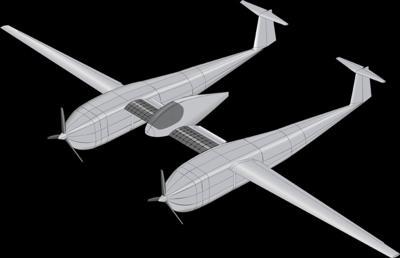
Piccard intends to do just that in his new project, named Climate Impulse. This fully hydrogen-powered aircraft is designed with the capability to fly non-stop around the equator in a short nine days. It is designed around the two hydrogen tanks, with a small central pod for the pilots in the middle. The propellers and tails are mounted on the tanks to increase stability.

“The major technological challenge,” explained design supervisor Raphaël Dinelli, “is to build an aircraft around two tanks of liquid hydrogen maintained at -253°C, powering electric motors via fuel cells.” To maintain the hydrogen’s liquid state for the full trip, the team is working to design “revolutionary” thermal tanks.

Piccard and his team intend to begin Climate Impulse testing within the next two years. Their target date for the circumnavigation is set for 2028.

FMI: www.bertrandpiccard.com

Advertisement

More News

Aero-TV: DeltaHawk’s Diesel Power Steps Into the Spotlight

Its Offerings Are Lighter, Cleaner, and Now Pushing Past 1,000nm on SAF Jet Fuel DeltaHawk’s diesel-powered aircraft lineup has seen incredible upgrades over the last few yea>[...]

NTSB Prelim: Mooney Aircraft Corp. M20K

The Airplane Experienced A Total Loss Of Engine Power On December 3, 2025, about 1600 central standard time, a Mooney Aircraft Corp. M20K, N57229, was substantially damaged when it>[...]

ANN FAQ: Turn On Post Notifications

Make Sure You NEVER Miss A New Story From Aero-News Network Do you ever feel like you never see posts from a certain person or page on Facebook or Instagram? Here’s how you c>[...]

ANN's Daily Aero-Linx (12.20.25)

Aero Linx: European Society of Aerospace Medicine (ESAM) As a pan-European, independent forum, it works to promote the safety and health of all persons involved in aviation and spa>[...]

Aero-News: Quote of the Day (12.20.25)

“We are excited to see Wisk achieve this milestone, and I’m so proud of the team that made it possible. The team at Wisk has built advanced technologies across flight c>[...]

blog comments powered by Disqus



Advertisement

Advertisement

Podcasts

Advertisement

© 2007 - 2025 Web Development & Design by Pauli Systems, LC

