
NATA Likes New Cargo Security Rule | Aero-News Network
Aero-News Network
RSS icon RSS feed
podcast icon MP3 podcast
Subscribe Aero-News e-mail Newsletter Subscribe

Airborne Unlimited -- Most Recent Daily Episodes

Episode Date

Airborne-Monday

Airborne-Tuesday

Airborne-Wednesday Airborne-Thursday

Airborne-Friday

Airborne On YouTube

Airborne-Unlimited-12.08.25

AirborneNextGen-
12.09.25

Airborne-Unlimited-12.10.25

Airborne-AffordableFlyers-12.11.25

AirborneUnlimited-12.05.25

AFE 2025 LIVE MOSAIC Town Hall (Archived): www.airborne-live.net

Fri, Nov 12, 2004

NATA Likes New Cargo Security Rule

Establishes "All Cargo" Program

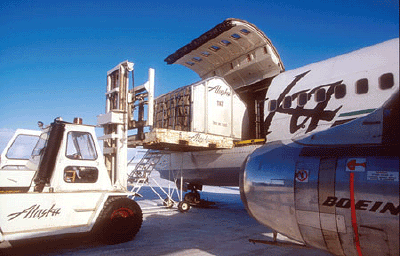
NATA Thursday praised the TSA for its efforts with the recent release of proposed rulemaking to enhance security for air cargo operations.

On Wednesday, November 10th, the TSA published a Notice of Proposed Rulemaking (NPRM) seeking to enhance the security of cargo transported on passenger and all-cargo aircraft. The NPRM would establish a new type of "all-cargo" program for aircraft weighing more than 45,500 kg. The proposed rule also calls for new security measures for cargo carried on passenger aircraft.

Any all-cargo aircraft weighing more than 12,500 pounds and up to 45,500 kg are currently regulated under the Twelve Five Standard Security Program (TFSSP) and would remain so regulated under the proposed rule. Most all-cargo aircraft currently subject to the TFSSP are Part 135 on-demand air carriers.

NATA is an active member of the Aviation Security Advisory Committee (ASAC) whose recommendations formed the basis for most of the NPRM. "Throughout the ASAC deliberations, NATA advocated on behalf of the small Part 135 carriers to ensure that the unique and diverse nature of their operations was recognized by the TSA," NATA President James K. Coyne explained. "We are pleased that the TSA has taken our concerns to heart by publishing a balanced approach to enhancing air cargo security.

"NATA supports the TSA's decision to retain smaller all-cargo aircraft under the Twelve Five Standard Security Program," Coyne explained. "We believe that the TFSSP provides an appropriate level of cargo security for the aircraft that participate in the program while recognizing their smaller size and operational environment that clearly have a different security risk profile than that of the large aircraft cargo haulers.

"NATA is pleased that the TSA has recognized that a one-size-fits-all approach to security is neither effective nor necessary. While we expect our comprehensive analysis of the NPRM to generate association recommendations for change, overall we believe this proposal takes the air cargo community in the right direction," Coyne concluded.

FMI: www.nata-online.org

Advertisement

More News

ANN's Daily Aero-Term (12.08.25): Decision Altitude (DA)

Decision Altitude (DA) A specified altitude (mean sea level (MSL)) on an instrument approach procedure (ILS, GLS, vertically guided RNAV) at which the pilot must decide whether to >[...]

ANN's Daily Aero-Linx (12.08.25)

Aero Linx: T-34 Association, Inc. The T-34 Association was formed in July 1975 so that individuals purchasing then military surplus T-34As had an organization which would provide s>[...]

NTSB Final Report: Piper PA-31T3

As He Released The Brakes To Begin Taxiing, The Brake Pedals Went To The Floor With No Braking Action Analysis: The pilot reported that during engine start up, he applied the brake>[...]

Aero-News: Quote of the Day (12.08.25)

“Legislation like the Mental Health in Aviation Act is still imperative to hold the FAA accountable for the changes they clearly acknowledge need to be made... We cannot wait>[...]

Airborne-Flight Training 12.04.25: Ldg Fee Danger, Av Mental Health, PC-7 MKX

Also: IAE Acquires Diamond Trainers, Army Drones, FedEx Pilots Warning, DA62 MPP To Dresden Tech Uni The danger to the flight training industry and our future pilots is clear. Dona>[...]

blog comments powered by Disqus



Advertisement

Advertisement

Podcasts

Advertisement

© 2007 - 2025 Web Development & Design by Pauli Systems, LC

