
Largest-Ever Solid Rocket Motor Poised For First Hot Firing | Aero-News Network
Aero-News Network
RSS icon RSS feed
podcast icon MP3 podcast
Subscribe Aero-News e-mail Newsletter Subscribe

Airborne Unlimited -- Most Recent Daily Episodes

Episode Date

Airborne-Monday

Airborne-Tuesday

Airborne-Wednesday Airborne-Thursday

Airborne-Friday

Airborne On YouTube

Airborne-Unlimited-12.08.25

AirborneNextGen-
12.09.25

Airborne-Unlimited-12.10.25

Airborne-AffordableFlyers-12.11.25

AirborneUnlimited-12.05.25

AFE 2025 LIVE MOSAIC Town Hall (Archived): www.airborne-live.net

Thu, Jul 12, 2018

Largest-Ever Solid Rocket Motor Poised For First Hot Firing

Will Validate Booster For Use On Vega-C And Ariane 6 Rockets

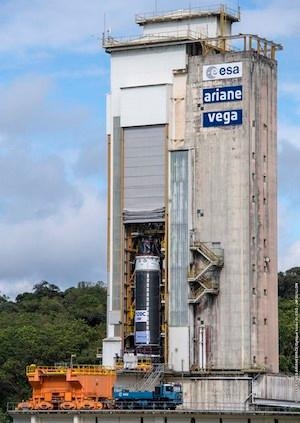
This week, the largest solid rocket motor ever built in one piece will be test fired at Europe’s Spaceport in French Guiana for the first time. This important milestone validates the booster for use on Vega-C next year and on Ariane 6 from 2020.

Fully loaded with solid fuel, the P120C rocket motor common to Europe’s future launchers Vega-C and Ariane 6, will be held vertically in the test stand and ignited. Sensors will gather about 600 measures during the test.

The P120C is 44 feet long and 11 feet in diameter, contains 142 metric tons of solid propellant and provides a maximum thrust of 1.04 million pounds (in vacuum) of thrust over a burn time of about 135 seconds. The design builds on existing expertise and lessons learned with Vega’s P80 first stage motor. P120C will replace P80 as the first stage motor of Vega-C. Two or four P120Cs will be strapped onto Ariane 6 as boosters for liftoff.

All main components of the motor such as nozzle, igniter, solid propellant, and insulated motor case have already been tested separately. This static firing will prove these technologies, materials and production techniques in combination and validate the behaviour of the assembled motor. The test stand with the tools and equipment that will secure the P120C for its test firing, have had to be modified or developed to accommodate this huge motor.

Recently a full-scale model of the P120C filled with inert propellant allowed engineers to verify tools, check connections and perfect procedures.

Information gathered during this static firing will allow engineers to compare their numerical models against observed reality to consolidate the P120C design.

This will guide the design of the P120C qualification motor that will be static fired at the end of the year.

(Image provided with ESA news release)

FMI: www.esa.int

Advertisement

More News

ANN's Daily Aero-Term (12.08.25): Decision Altitude (DA)

Decision Altitude (DA) A specified altitude (mean sea level (MSL)) on an instrument approach procedure (ILS, GLS, vertically guided RNAV) at which the pilot must decide whether to >[...]

ANN's Daily Aero-Linx (12.08.25)

Aero Linx: T-34 Association, Inc. The T-34 Association was formed in July 1975 so that individuals purchasing then military surplus T-34As had an organization which would provide s>[...]

NTSB Final Report: Piper PA-31T3

As He Released The Brakes To Begin Taxiing, The Brake Pedals Went To The Floor With No Braking Action Analysis: The pilot reported that during engine start up, he applied the brake>[...]

Aero-News: Quote of the Day (12.08.25)

“Legislation like the Mental Health in Aviation Act is still imperative to hold the FAA accountable for the changes they clearly acknowledge need to be made... We cannot wait>[...]

Airborne-Flight Training 12.04.25: Ldg Fee Danger, Av Mental Health, PC-7 MKX

Also: IAE Acquires Diamond Trainers, Army Drones, FedEx Pilots Warning, DA62 MPP To Dresden Tech Uni The danger to the flight training industry and our future pilots is clear. Dona>[...]

blog comments powered by Disqus



Advertisement

Advertisement

Podcasts

Advertisement

© 2007 - 2025 Web Development & Design by Pauli Systems, LC

