
Small Asteroid To Safely Pass Close To Earth Sunday | Aero-News Network
Aero-News Network
RSS icon RSS feed
podcast icon MP3 podcast
Subscribe Aero-News e-mail Newsletter Subscribe

Airborne Unlimited -- Most Recent Daily Episodes

Episode Date

Airborne-Monday

Airborne-Tuesday

Airborne-Wednesday Airborne-Thursday

Airborne-Friday

Airborne On YouTube

Airborne-Unlimited-12.01.25

AirborneNextGen-
12.02.25

Airborne-Unlimited-12.03.25

Airborne-FltTraining-12.04.25

AirborneUnlimited-12.05.25

AFE 2025 LIVE MOSAIC Town Hall (Archived): www.airborne-live.net

Sat, Sep 06, 2014

Small Asteroid To Safely Pass Close To Earth Sunday

Closest Approach Will Be About 25,000 Miles From Our Planet

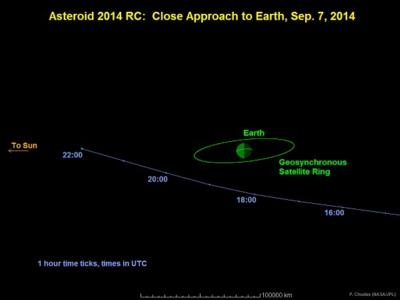
A small asteroid, designated 2014 RC, will safely pass very close to Earth on Sunday, Sept. 7, 2014.  At the time of closest approach, based on current calculations to be about 2:18 p.m. EDT, the asteroid will be roughly over New Zealand.  From its reflected brightness, astronomers estimate that the asteroid is about 60 feet in size.

Asteroid 2014 RC was initially discovered on the night of August 31 by the Catalina Sky Survey near Tucson, Arizona, and independently detected the next night by the Pan-STARRS 1 telescope, located on the summit of HaleakalA? on Maui, Hawaii.  Both reported their observations to the Minor Planet Center in Cambridge, Massachusetts.  Additional follow-up observations by the Catalina Sky Survey and the University of Hawaii 88-inch telescope on Mauna Kea confirmed the orbit of 2014 RC.

At the time of closest approach, 2014 RC will be approximately one-tenth the distance from the center of Earth to the moon, or about 25,000 miles. The asteroid's apparent magnitude at that time will be about 11.5, rendering it unobservable to the unaided eye.  However, amateur astronomers with small telescopes might glimpse the fast-moving appearance of this near-Earth asteroid.

The asteroid will pass below Earth and the geosynchronous ring of communications and weather satellites orbiting about 22,000 miles above our planet’s surface.  While this celestial object does not appear to pose any threat to Earth or satellites, its close approach creates a unique opportunity for researchers to observe and learn more about asteroids.

While 2014 RC will not impact Earth, its orbit will bring it back to our planet's neighborhood in the future.  The asteroid's future motion will be closely monitored, but no future threatening Earth encounters have been identified.

(Image provided by NASA)

FMI: www.nasa.gov

Advertisement

More News

ANN's Daily Aero-Linx (12.03.25)

Aero Linx: American Aviation Historical Society AAHS is dedicated to the preservation and dissemination of the rich heritage of American aviation. Our purpose is to collect, preser>[...]

ANN's Daily Aero-Term (12.03.25): CrewMember (UAS)

CrewMember (UAS) A person assigned to perform an operational duty. A UAS crewmember includes the remote pilot in command, the person manipulating the controls, and visual observers>[...]

NTSB Prelim: Maule M-7-235A

Immediately After The Right Main Tire Contacted The Runway Surface, The Right Main Landing Gear Failed On October 31, 2025, at about 1227 Pacific daylight time, a Maule M-7-235A, N>[...]

Airborne-Flight Training 12.04.25: Ldg Fee Danger, Av Mental Health, PC-7 MKX

Also: IAE Acquires Diamond Trainers, Army Drones, FedEx Pilots Warning, DA62 MPP To Dresden Tech Uni The danger to the flight training industry and our future pilots is clear. Dona>[...]

Aero-News: Quote of the Day (12.04.25)

"On December 3, 2025, at approximately 10:45 a.m., a Thunderbird pilot ejected safely from a F-16C Fighting Falcon aircraft during a training mission over controlled airspace in Ca>[...]

blog comments powered by Disqus



Advertisement

Advertisement

Podcasts

Advertisement

© 2007 - 2025 Web Development & Design by Pauli Systems, LC

