TARC Announces Top 100 Teams Competing For National Championship
This May, students will prove that for both their dreams and their scientific expertise, the sky truly is the limit. As part of the 15th annual Team America Rocketry Challenge (TARC) National Finals, one hundred finalist teams of middle and high school students representing 28 states and the U.S. Virgin Islands will travel to Washington with the goal of taking home a trophy and a chance to represent the United States internationally later this year. The finalists outscored more than 700 other teams to earn one of the coveted spots to compete at the Final Fly-Offs on Saturday, May 13 outside of Washington, D.C
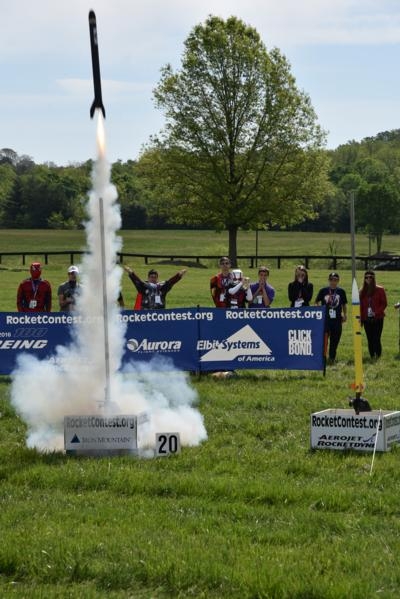
The competition itself challenges students across the development and design process, where in addition to building a rocket that flies to exactly 775 feet and safely returns a payload of one raw egg undamaged within 41-43 seconds, teams must include a transition piece that joins two different diameters of body tube. Reflecting the innovative and curious nature at the heart of the aerospace workforce, some teams have met the mark while still managing to include 3D printing and other innovative strategies into their designs.
At the National Finals, as many as 42 teams will advance to a second round with new height and time requirements (800 feet and 42-44 seconds). Teams must rely on their knowledge of physics to adequately adjust their rockets on the fly in order to meet the new scoring parameters in an unfamiliar launch environment.
Finalists will compete for scholarships and prizes totaling more than $100,000 and the chance to travel to the Paris Air Show, courtesy of the Raytheon Company. The winning team will represent the United States in the International Rocketry Challenge, facing off against teams from the United Kingdom, France and Japan.
As important as the Finals are, the lessons in getting there are equally as critical. TARC's structure mirrors that of the aerospace industry's design, engineering and testing processes, with many TARC participants carrying the lessons they learned in TARC competition through to joining a thriving and innovative aerospace workforce in the future.
Through the 2017 finalists' cross-section of cultural experiences, there is a glimpse into a growing future of the STEM and aerospace workforce leaders. Within the hundreds of students invited, approximately 1 in 3 are female rocketeers, including six all-girl teams. In addition, these students offer unique experiences from a number of socioeconomic backgrounds. The teams hail from both rural and urban America, encompassing first-time rocketeers and program veterans. They also feature teams that were completely self-funded and student run as well as those who have some support from sponsors. Ultimately, these middle and high school students are proof that STEM and aerospace are for everyone, and the push for a strong diverse workforce is happening now.
Sponsored by the Aerospace Industries Association, the National Association of Rocketry and more than 20 industry partners, TARC is the world's largest student rocketry contest. Since its inception in 2002, TARC has inspired more than 65,000 middle and high school students to explore careers in science, technology, engineering and mathematics (STEM). This year, nearly 5,000 students representing 46 states, the District of Columbia and the U.S. Virgin Islands designed, built and launched rockets in hopes of qualifying for the National Finals.
(Source: AIA news release. Image from 2016 event)



 ANN's Daily Aero-Term (12.08.25): Decision Altitude (DA)


 See All