
Vultee BT-13 Joins LSFM Permanent Collection | Aero-News Network
Aero-News Network
RSS icon RSS feed
podcast icon MP3 podcast
Subscribe Aero-News e-mail Newsletter Subscribe

Airborne Unlimited -- Most Recent Daily Episodes

Episode Date

Airborne-Monday

Airborne-Tuesday

Airborne-Wednesday Airborne-Thursday

Airborne-Friday

Airborne On YouTube

Airborne-Unlimited-12.08.25

AirborneNextGen-
12.09.25

Airborne-Unlimited-12.10.25

Airborne-AffordableFlyers-12.11.25

AirborneUnlimited-12.12.25

AFE 2025 LIVE MOSAIC Town Hall (Archived): www.airborne-live.net

Thu, Mar 11, 2021

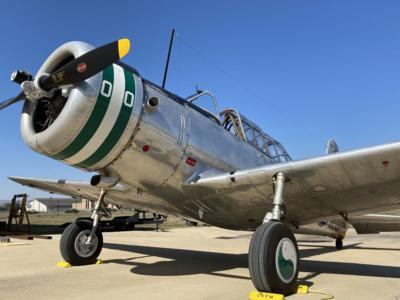
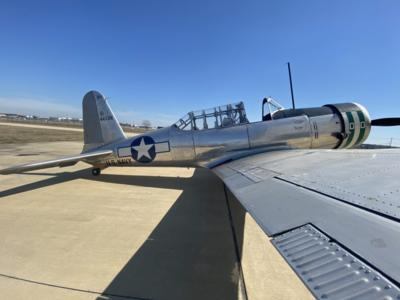
Vultee BT-13 Joins LSFM Permanent Collection

It Is Estimated That Fewer Than 40 BT-13s Remain

One of the most widely used trainers during WWII, the BT-13 was much more complex than the other primary trainers. It possessed a more powerful engine, was faster and heavier, had landing flaps and a two-position variable pitch propeller, and flying the BT-13 required two-way communicate with ground personnel. Today it is estimated that fewer than 40 BT-13s remain in flying condition.

Donated to the museum by Mike Abajian, a retired Marine lieutenant colonel, the BT-13 was built for the Navy in San Diego near the end of World War II. Navy variants of the BT-13 were given the designation SNV (a scout trainer built by Vultee). The aircraft spent its entire service career at the Great Lakes Naval Station, where it was used as a “station hack”. A station hack,(a.k.a. a “squadron hack” was an aircraft assigned to a base that primarily flew other types of aircraft than the hack aircraft.

The Vultee BT-13, Boeing Stearman PT-17 and the Fairchild PT-19 were the three most widely used trainers employed by the United States military during World War II.

Training for new pilots consisted of four 10-week phases. The first phase of training was conducted in the classroom. The second through fourth phases consisted of cockpit flying experience, with each phase being progressively more challenging than the last, and each phase introducing the pilot candidate to a more challenging and sophisticated aircraft. The phases were respectively named Primary, Basic, and Advanced training. The Boeing Stearman PT-17 or the Fairchild PT-19 were used for Primary training, the Vultee BT-13 was commonly used for Basic training, and the North American AT-6 was used for Advanced training.

In the late 1930s Vultee used its own money to develop a military trainer. However, the US Army Air Corps considered the engine of the trainer too powerful and the aircraft too complex for fledgling pilots. Vultee responded by building a new trainer which became the BT-13. The Army Air Corps ordered 300 of the aircraft in 1939, an order that was the largest of its kind at the time.

The Lone Star Flight Museum is a 501(c)(3) aviation museum and STEM learning center with a mission to preserve, educate and inspire. Led by CEO, Lt. Gen. (Ret.) Douglas H. Owens, LSFM’s new $38 million state of the art facility at Houston’s Ellington Airport opened September 16, 2017. In addition to the Texas Aviation Hall of Fame, the 130,000 square foot facility houses the Museum’s renowned flying collection of historic aircraft, a $1 million, high-tech Aviation Learning Center and dynamic hands-on exhibits.

FMI: www.lonestarflight.org/

Advertisement

More News

Aero-News: Quote of the Day (12.09.25)

“We respectfully call on the City of Mesa to: 1. Withdraw the landing fee proposal immediately 2. Engage with the aviation community before making decisions that impact safet>[...]

ANN's Daily Aero-Term (12.09.25): High Speed Taxiway

High Speed Taxiway A long radius taxiway designed and provided with lighting or marking to define the path of aircraft, traveling at high speed (up to 60 knots), from the runway ce>[...]

ANN's Daily Aero-Linx (12.09.25)

Aero Linx: International Federation of Airworthiness (IFA) IFA uniquely combines together all those with responsibility for policies, principles and practices concerned with the co>[...]

NTSB Final Report: Diamond Aircraft Ind Inc DA20C1 (A1); Robinson Helicopter R44

Controller’s Expectation That VW02 Would Have Departed Sooner Led To An Inadequate Scan And Loss Of Situational Awareness Analysis: A Robinson R-44 helicopter N744AF, VW02 (V>[...]

ANN FAQ: Q&A 101

A Few Questions AND Answers To Help You Get MORE Out of ANN! 1) I forgot my password. How do I find it? 1) Easy... click here and give us your e-mail address--we'll send it to you >[...]

blog comments powered by Disqus



Advertisement

Advertisement

Podcasts

Advertisement

© 2007 - 2025 Web Development & Design by Pauli Systems, LC

