
NTSB Wants Fixes To Airbus Cockpit Electronics | Aero-News Network
Aero-News Network
RSS icon RSS feed
podcast icon MP3 podcast
Subscribe Aero-News e-mail Newsletter Subscribe

Airborne Unlimited -- Most Recent Daily Episodes

Episode Date

Airborne-Monday

Airborne-Tuesday

Airborne-Wednesday Airborne-Thursday

Airborne-Friday

Airborne On YouTube

Airborne-Unlimited-12.22.25

AirborneNextGen-
12.23.25

Airborne-Unlimited-12.10.25

Airborne-FltTraining-12.18.25

AirborneUnlimited-12.19.25

AFE 2025 LIVE MOSAIC Town Hall (Archived): www.airborne-live.net

Thu, Jul 24, 2008

NTSB Wants Fixes To Airbus Cockpit Electronics

49 Reported Cases Of Dark Displays In Recent Years

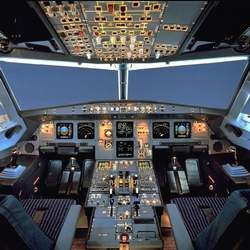
Few would argue that so-called "glass cockpits" are a major leap forward in cockpit management and crew safety... until those panels go dark in-flight, which the National Transportation Safety Board says has happened at least 49 times in recent years onboard several Airbus airliners.

On Wednesday, the NTSB issued five recommendations to address concerns about cockpit displays going inop on Airbus A319 and A320 narrowbodies. Of the 49 incidents reported to the Board, seven involved all six cockpit displays going blank at once... something safety experts once thought was all-but impossible.

Sixteen planes lost five of the six cockpit displays. In addition to flight instruments and engine monitoring systems, loss of the avionics displays also resulted in the loss of comm systems, transponders, and traffic advisory systems.

In January of this year, a United A320 had to make a hasty return to Newark Liberty, when the captain's primary flight display (PFD) and navigational display (ND), along with the upper electronic centralized aircraft monitoring (ECAM) display, went blank on takeoff. The plane was able to make a safe emergency landing, helped greatly by the fact conditions were VMC.

The NTSB notes the first officer's ND remained functional, as did the lower ECAM display. The first officer also reported that the attitude information on his PFD was initially not usable, but that the information appeared to be reliable later in the flight.

Those circumstances were similar to those experienced onboard a British Airways A319 three years before, which suffered failures to five of six cockpit displays while cruising at FL200 from London to Budapest. Most of the screens returned within 90 seconds.

British investigators have already issued safety recommendations related to the problem, and Airbus issued a safety bulletin in May 2007 recommending new wiring fixes and increased crew training on how to handle electrical systems failures. But those fixes aren't mandatory, and the NTSB says they should be.

Included in the six recommendations from the NTSB are calls for a backup power supply to be added to the standby attitude indicator, and the automatic reconfiguration of the AC essential bus power supply in the event that the AC 1 electrical bus fails. The NTSB also wants greater crew training, and additional simulator time for pilots to learn how to handle such failures.

FMI: Read The NTSB Recommendtions Here And Here (.pdfs)

Advertisement

More News

Classic Aero-TV: In Praise of Alabama’s Patriot Aircraft USA

From 2023 (YouTube Edition): "Ain’t Your Daddy’s Super Cub”—Don Wade Co-owned by Don and Ron Wade—the former of Don’s Dream Machines, a storied >[...]

NTSB Final Report: Cirrus Design Corp SR22

Pilot-Rated Passenger Reported That The Pilot Did Not Adequately “Round Out” The Landing Flare And The Airplane Bounced And Yawed To The Right Analysis: The pilot state>[...]

ANN's Daily Aero-Term (12.21.25): Dead Reckoning

Dead Reckoning Dead reckoning, as applied to flying, is the navigation of an airplane solely by means of computations based on airspeed, course, heading, wind direction, and speed,>[...]

ANN's Daily Aero-Linx (12.21.25)

Aero Linx: Lake Amphibian Club This website is created and sponsored by the Lake Amphibian Club, to help spread the word about these wonderful, versatile amphibians that can land j>[...]

Aero-News: Quote of the Day (12.21.25)

“I am deeply honored to be sworn in as NASA administrator. NASA’s mission is as imperative and urgent as ever — to push the boundaries of human exploration, ignit>[...]

blog comments powered by Disqus



Advertisement

Advertisement

Podcasts

Advertisement

© 2007 - 2025 Web Development & Design by Pauli Systems, LC

