
NASA to Attach, Test First Expandable Habitat On ISS | Aero-News Network
Aero-News Network
RSS icon RSS feed
podcast icon MP3 podcast
Subscribe Aero-News e-mail Newsletter Subscribe

Airborne Unlimited -- Most Recent Daily Episodes

Episode Date

Airborne-Monday

Airborne-Tuesday

Airborne-Wednesday Airborne-Thursday

Airborne-Friday

Airborne On YouTube

Airborne-Unlimited-12.08.25

AirborneNextGen-
12.09.25

Airborne-Unlimited-12.10.25

Airborne-AffordableFlyers-12.11.25

AirborneUnlimited-12.12.25

AFE 2025 LIVE MOSAIC Town Hall (Archived): www.airborne-live.net

Thu, Apr 14, 2016

NASA to Attach, Test First Expandable Habitat On ISS

BEAM Launched By SpaceX To The Station April 8

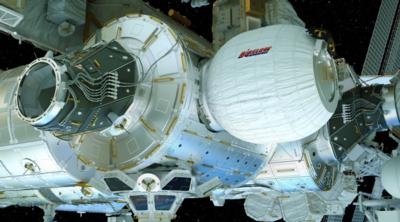
The first human-rated expandable structure that may help inform the design of deep space habitats is set to be installed to the International Space Station Saturday, April 16.

The Bigelow Expandable Activity Module (BEAM) will be attached to the station's Tranquility module over a period of about four hours. Controllers in mission control at NASA's Johnson Space Center in Houston will remove BEAM from the unpressurized trunk of SpaceX's Dragon spacecraft, using the robotic Canadarm2, and move it into position next to Tranquility's aft assembly port. NASA astronauts aboard the station will secure BEAM using common berthing mechanism controls. Robotic operations begin at 2:15 a.m. and are expected to be complete by 6:15 a.m.

BEAM launched aboard Dragon on April 8 from Cape Canaveral Air Force Station in Florida. At the end of May, the module will be expanded to nearly five times its compressed size of 7 feet in diameter by 8 feet in length to roughly 10 feet in diameter and 13 feet in length.

Astronauts will first enter the habitat about a week after expansion and, during a two-year test mission, will return to the module for a few hours several times a year to retrieve sensor data and assess conditions.

Expandable habitats are designed to take up less room on a rocket, but provide greater volume for living and working in space once expanded. This first test of an expandable module will allow investigators to gauge how well the habitat performs overall and, specifically, how well it protects against solar radiation, space debris and the temperature extremes of space. Once the test period is over, BEAM will be released from the space station, and will burn up during its descent through Earth's atmosphere.

BEAM is an example of NASA's increased commitment to partnering with industry to enable the growth of the commercial use of space. The BEAM project is co-sponsored by NASA's Advanced Exploration Systems Division and Bigelow Aerospace.

The International Space Station serves as the world's leading laboratory for conducting cutting-edge microgravity research and is the primary platform for technology development and testing in space to enable human and robotic exploration of destinations beyond low-Earth orbit, including asteroids and Mars.

(Image provided with NASA news release)

FMI: www.nasa.gov/beam

Advertisement

More News

Aero-News: Quote of the Day (12.11.25)

"The owners envisioned something modern and distinctive, yet deeply meaningful. We collaborated closely to refine the flag design so it complemented the aircraft’s contours w>[...]

ANN's Daily Aero-Term (12.11.25): Nonradar Arrival

Nonradar Arrival An aircraft arriving at an airport without radar service or at an airport served by a radar facility and radar contact has not been established or has been termina>[...]

Classic Aero-TV: David Uhl and the Lofty Art of Aircraft Portraiture

From 2022 (YouTube Edition): Still Life with Verve David Uhl was born into a family of engineers and artists—a backdrop conducive to his gleaning a keen appreciation for the >[...]

Airborne-NextGen 12.09.25: Amazon Crash, China Rocket Accident, UAV Black Hawk

Also: Electra Goes Military, Miami Air Taxi, Hypersonics Lab, MagniX HeliStrom Amazon’s Prime Air drones are back in the spotlight after one of its newest MK30 delivery drone>[...]

Airborne 12.05.25: Thunderbird Ejects, Lost Air india 737, Dynon Update

Also: Trailblazing Aviator Betty Stewart, Wind Farm Scrutiny, Chatham Ban Overturned, Airbus Shares Dive A Thunderbird pilot, ID'ed alternately as Thunderbird 5 or Thunderbird 6, (>[...]

blog comments powered by Disqus



Advertisement

Advertisement

Podcasts

Advertisement

© 2007 - 2025 Web Development & Design by Pauli Systems, LC

