
Solar Ultraviolet Imager Ready To Fly On NOAA Satellite | Aero-News Network
Aero-News Network
RSS icon RSS feed
podcast icon MP3 podcast
Subscribe Aero-News e-mail Newsletter Subscribe

Airborne Unlimited -- Most Recent Daily Episodes

Episode Date

Airborne-Monday

Airborne-Tuesday

Airborne-Wednesday Airborne-Thursday

Airborne-Friday

Airborne On YouTube

Airborne-SpecialEpisode-12.15.25

AirborneNextGen-
12.16.25

Airborne-Unlimited-12.10.25

Airborne-AffordableFlyers-12.11.25

AirborneUnlimited-12.12.25

AFE 2025 LIVE MOSAIC Town Hall (Archived): www.airborne-live.net

Mon, Dec 23, 2013

Solar Ultraviolet Imager Ready To Fly On NOAA Satellite

Lockheed Martin To Deliver The Instrument In January

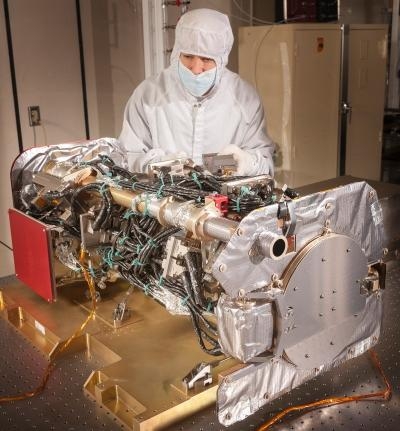
A Lockheed Martin team has completed the Solar Ultraviolet Imager (SUVI) instrument that will make crucial solar measurements when it flies on the National Oceanic and Atmospheric Administration's (NOAA) next-generation Geostationary Operational Environmental Satellite (GOES) satellite missions, known as the GOES-R series.

The team is on track for instrument delivery in January 2014 for integration with the first GOES-R spacecraft at Lockheed Martin's Space Systems facility in Denver. The advanced spacecraft and instrument technology used on the GOES-R series is expected to improve the quality and timeliness of forecasts, expanding the safety and economic benefits to the public.

"We are enormously pleased to have reached this milestone with our first SUVI flight unit," said Mons Morrison, Lockheed Martin SUVI program manager at the Advanced Technology Center (ATC) in Palo Alto. "We look forward to continuing our collaboration with NASA and NOAA to produce the best possible instrument – and to work side by side with our Lockheed Martin Civil Space colleagues who are designing and building the GOES-R spacecraft."

The SUVI will provide the required solar observational capabilities that enable NOAA's Space Weather Prediction Center in Boulder, CO. to monitor solar activity and to issue accurate, real-time alerts when space weather may possibly affect the performance and reliability of space-borne and ground-based technological systems. Space weather can disrupt satellite operations, communications, navigation, and the distribution of electricity through power grids. These can lead to economic losses and can potentially endanger human life.

Operational since 1975, the GOES program is operated by NOAA's National Environmental Satellite, Data, and Information Service (NESDIS) and is a critical part of the U.S. satellite constellation for environmental observations. The GOES satellites are a key element in NOAA's National Weather Service (NWS) operations, providing a continuous stream of environmental information (weather imagery and sounding data) used to support weather forecasting, severe-storm tracking, and meteorological research. Along with weather forecasting, the GOES program also provides data to support space weather forecasting, public safety, and scientific researchers use the data to better understand land, atmosphere, ocean, and climate interactions.

(Image provided by Lockheed Martin)

FMI: www.lochkeedmartin.com

Advertisement

More News

ANN's Daily Aero-Term (12.19.25): Ultrahigh Frequency (UHF)

Ultrahigh Frequency (UHF) The frequency band between 300 and 3,000 MHz. The bank of radio frequencies used for military air/ground voice communications. In some instances this may >[...]

NTSB Prelim: Cirrus Design Corp SR22T

During The 7 Second Descent, There Was Another TAWS Alert At Which Time The Engine Remained At Full Power On October 24, 2025 at 2115 mountain daylight time, a Cirrus SR22T, N740TS>[...]

Classic Aero-TV: The Red Tail Project--Carrying the Torch of the Tuskegee Airmen

From 2009 (YouTube Edition): Educational Organization Aims to Inspire by Sharing Tuskegee Story Founding leader Don Hinz summarized the Red Tail Project’s mission in simple, >[...]

Aero-News: Quote of the Day (12.19.25)

“This feels like an important step since space travel for people with disabilities is still in its very early days... I’m so thankful and hope it inspires a change in m>[...]

Airborne 12.17.25: Skydiver Hooks Tail, Cooper Rotax Mount, NTSB v NDAA

Also: New Katanas, Kern County FD Training, IndiGo’s Botched Roster, MGen. Leavitt Named ERAU Dean The Australian Transportation Safety Bureau (ATSB) has wrapped up its inves>[...]

blog comments powered by Disqus



Advertisement

Advertisement

Podcasts

Advertisement

© 2007 - 2025 Web Development & Design by Pauli Systems, LC

