Sat, Aug 24, 2013
Trains Astronauts For Reduced Mobility When Wearing A Pressurized Suit
Aurora Flight Sciences has delivered a completed Space Suit Simulator (S3) to NASA following the successful completion of a Phase II Small Business Innovative Research effort. Aurora collaborated with Professors Dava Newman and Jeffrey Hoffman of the Massachusetts Institute of Technology (MIT) Department of Aeronautics and Astronautics, as well as Professor Grant Schaffner from the University of Cincinnati, for this program.
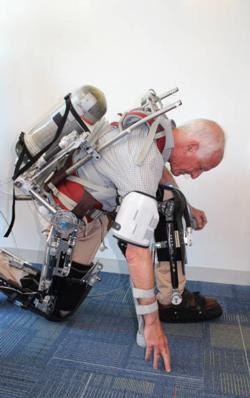
The S3 was developed to meet NASA's research and training needs. Pressurized space suits impose high joint torques on the astronaut, reducing mobility for upper and lower body motions. Because of the highly altered mobility capabilities and metabolic cost of movement when wearing a space suit, it is necessary for suits to be worn during many aspects of astronaut training and ground-based research. Using actual space suits is problematic due to the expense, bulk, weight in Earth's gravity, and difficulty in donning/doffing.
Aurora has developed a low-profile, lightweight, space suit simulator to provide high-fidelity emulation of NASA's Extra-Vehicular Mobility Unit, the EMU. "An astronaut experiences resistance from the space suit primarily in his or her joints, such as the knees, hips, and shoulders. We have developed an exoskeleton that includes actively controlled resistive elements at each of the lower body joints," said Dr. Jessica Duda, Aurora's Principal Investigator for this project. "By using active control, we are also able to calibrate the joint torques for current or future space suits." The current EMU requires very high metabolic costs (fatigue and calories burned) due to the energy required to bend the pressurized limbs. Future suit designs will focus on reducing joint torques. The S3 provides a means of measuring the metabolic costs of various joint torque configurations to aid in developing an optimized design.
Working with MIT, Aurora tested each of the joint concepts on an anthropometric robot with instrumented joints and verified the torques provided by each of the joints. The completed S3 is adjustable for human subjects up to 95th percentile male and is expected to be used in university field trials this summer.
(Image provided by Aurora)
More News
From 2023 (YouTube Edition): "Ain’t Your Daddy’s Super Cub”—Don Wade Co-owned by Don and Ron Wade—the former of Don’s Dream Machines, a storied >[...]
Pilot-Rated Passenger Reported That The Pilot Did Not Adequately “Round Out” The Landing Flare And The Airplane Bounced And Yawed To The Right Analysis: The pilot state>[...]
Dead Reckoning Dead reckoning, as applied to flying, is the navigation of an airplane solely by means of computations based on airspeed, course, heading, wind direction, and speed,>[...]
Aero Linx: Lake Amphibian Club This website is created and sponsored by the Lake Amphibian Club, to help spread the word about these wonderful, versatile amphibians that can land j>[...]
“I am deeply honored to be sworn in as NASA administrator. NASA’s mission is as imperative and urgent as ever — to push the boundaries of human exploration, ignit>[...]



 Classic Aero-TV: In Praise of Alabamas Patriot Aircraft USA


 See All