Tue, May 12, 2015
DARPA Aiming To Share Breakthrough, Low-Cost Technologies
Tern, a joint program between DARPA and the U.S. Navy’s Office of Naval Research (ONR), seeks to give forward-deployed small ships the unprecedented capacity to serve as mobile launch and recovery platforms for medium-altitude, long-endurance unmanned aerial systems (UAS).

These systems would provide long-range intelligence, surveillance and reconnaissance (ISR) and other capabilities over greater distances and time periods than helicopters and would require far less dedicated infrastructure resources than conventional fixed-wing manned and unmanned aircraft. As part of its individual investment in Tern, DARPA has launched two successful technology demonstration efforts that grew from Phase 1 research and are separately approaching potential transition to the Services:
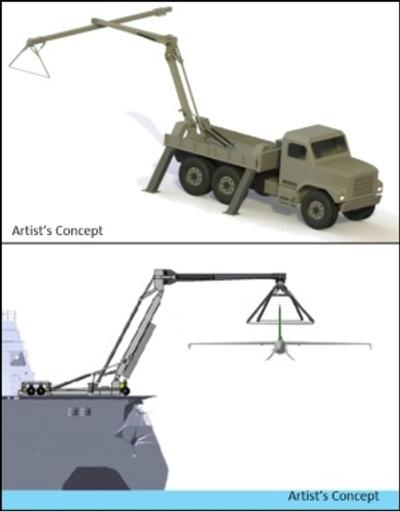
SideArm: DARPA’s SideArm effort seeks to create a self-contained, portable apparatus able to horizontally launch and retrieve UAS of up to 900 pounds from trucks, ships and fixed ground facilities. The small-footprint system is designed to enable rapid setup and controlled decelerations and adapt to current and future UAS. Based on subscale tests last summer, DARPA will conduct further risk reduction and hardware testing this year, and then plans to test recovery of two different aircraft types at full scale.
Towed Airborne Lift of Naval Systems (TALONS): DARPA’s TALONS effort seeks to develop a low-cost, fully automated parafoil system to extend small ships’ long?distance communications and improve their maritime domain awareness. Towed behind boats or ships, TALONS could carry ISR and communications payloads of up to 150 pounds between 500 and 1,500 feet in altitude—many times higher than current ships’ masts—and greatly extend the equipment’s range and effectiveness. Following successful ground-based tests, DARPA will conduct at-sea testing this year and potentially transition the technology to the U.S. Navy.
“Through SideArm, TALONS and other projects, DARPA aims to make it much easier, quicker and less expensive for the Defense Department to deploy persistent ISR and strike capabilities almost anywhere in the world,” said Dan Patt, DARPA program manager.
(Images provided by DARPA)
More News
Decision Altitude (DA) A specified altitude (mean sea level (MSL)) on an instrument approach procedure (ILS, GLS, vertically guided RNAV) at which the pilot must decide whether to >[...]
Aero Linx: T-34 Association, Inc. The T-34 Association was formed in July 1975 so that individuals purchasing then military surplus T-34As had an organization which would provide s>[...]
As He Released The Brakes To Begin Taxiing, The Brake Pedals Went To The Floor With No Braking Action Analysis: The pilot reported that during engine start up, he applied the brake>[...]
“Legislation like the Mental Health in Aviation Act is still imperative to hold the FAA accountable for the changes they clearly acknowledge need to be made... We cannot wait>[...]
Also: IAE Acquires Diamond Trainers, Army Drones, FedEx Pilots Warning, DA62 MPP To Dresden Tech Uni The danger to the flight training industry and our future pilots is clear. Dona>[...]



 ANN's Daily Aero-Term (12.08.25): Decision Altitude (DA)


 See All