
Critical Design Review Complete For Space Launch System Exploration Upper Stage | Aero-News Network
Aero-News Network
RSS icon RSS feed
podcast icon MP3 podcast
Subscribe Aero-News e-mail Newsletter Subscribe

Airborne Unlimited -- Most Recent Daily Episodes

Episode Date

Airborne-Monday

Airborne-Tuesday

Airborne-Wednesday Airborne-Thursday

Airborne-Friday

Airborne On YouTube

Airborne-SpecialEpisode-12.15.25

AirborneNextGen-
12.16.25

Airborne-Unlimited-12.10.25

Airborne-AffordableFlyers-12.11.25

AirborneUnlimited-12.12.25

AFE 2025 LIVE MOSAIC Town Hall (Archived): www.airborne-live.net

Wed, Dec 23, 2020

Critical Design Review Complete For Space Launch System Exploration Upper Stage

The Next Version Of SLS, Block 1B, Will Use EUS

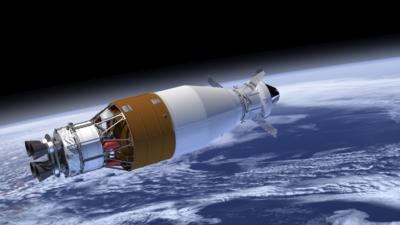
NASA has successfully completed a critical design review for NASA’s Space Launch System (SLS) Exploration Upper Stage (EUS), confirming the EUS design for continued development and transition to hardware build. Boeing has already started fabrication activities that will support building the first EUS at NASA’s Michoud Assembly Facility in New Orleans.

The SLS rocket uses staged propulsion to send NASA’s Orion spacecraft and astronauts, plus supplies, to the moon and beyond. The Boeing-built core stage powers the SLS in early flight, eventually separating when the upper stage takes over and provides the power to send crewed vehicles, space habitats and other payloads on to the moon or other deep space destinations.

To accomplish NASA’s Artemis I lunar mission, the Block 1 variant of SLS will use a Boeing/United Launch Alliance Interim Cryogenic Propulsion Stage with one RL-10 engine to take an uncrewed Orion spacecraft on a test flight to the moon. SLS Block 1 rockets will be used for two subsequent crewed flights, including the first human mission to lunar orbit since the Apollo program.

The next version of SLS, Block 1B, will use EUS, which has larger fuel tanks and four RL-10 engines to give it a performance boost. That will allow SLS Block 1B to carry an Orion with a crew of four, as well as more than 10 metric tons of co-manifested payload.

FMI: www.nasa.gov/sls

Advertisement

More News

ANN's Daily Aero-Term (12.19.25): Ultrahigh Frequency (UHF)

Ultrahigh Frequency (UHF) The frequency band between 300 and 3,000 MHz. The bank of radio frequencies used for military air/ground voice communications. In some instances this may >[...]

NTSB Prelim: Cirrus Design Corp SR22T

During The 7 Second Descent, There Was Another TAWS Alert At Which Time The Engine Remained At Full Power On October 24, 2025 at 2115 mountain daylight time, a Cirrus SR22T, N740TS>[...]

Classic Aero-TV: The Red Tail Project--Carrying the Torch of the Tuskegee Airmen

From 2009 (YouTube Edition): Educational Organization Aims to Inspire by Sharing Tuskegee Story Founding leader Don Hinz summarized the Red Tail Project’s mission in simple, >[...]

Aero-News: Quote of the Day (12.19.25)

“This feels like an important step since space travel for people with disabilities is still in its very early days... I’m so thankful and hope it inspires a change in m>[...]

Airborne 12.17.25: Skydiver Hooks Tail, Cooper Rotax Mount, NTSB v NDAA

Also: New Katanas, Kern County FD Training, IndiGo’s Botched Roster, MGen. Leavitt Named ERAU Dean The Australian Transportation Safety Bureau (ATSB) has wrapped up its inves>[...]

blog comments powered by Disqus



Advertisement

Advertisement

Podcasts

Advertisement

© 2007 - 2025 Web Development & Design by Pauli Systems, LC

