

Army Calls in Replacements for UH-60 Black Hawk Fleet | Aero-News Network
Aero-News Network
RSS icon RSS feed
podcast icon MP3 podcast
Subscribe Aero-News e-mail Newsletter Subscribe

Airborne Unlimited -- Most Recent Daily Episodes

Episode Date

Airborne-Monday

Airborne-Tuesday

Airborne-Wednesday Airborne-Thursday

Airborne-Friday

Airborne On YouTube

Airborne-Unlimited-12.08.25

AirborneNextGen-
12.09.25

Airborne-Unlimited-12.10.25

Airborne-AffordableFlyers-12.11.25

AirborneUnlimited-12.05.25

AFE 2025 LIVE MOSAIC Town Hall (Archived): www.airborne-live.net

Tue, Dec 10, 2024

Army Calls in Replacements for UH-60 Black Hawk Fleet

Introduces FLRAA to Get ‘Twice as Far, Twice as Fast’

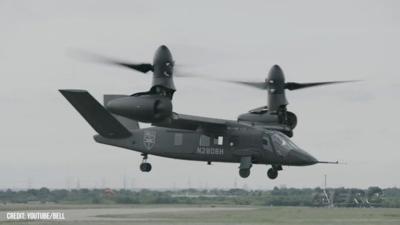
The US Army recently introduced its new Future Long-Range Assault Aircraft (FLRAA). The rotorcraft aims to replace parts of the existing UH-60 Black Hawk fleet and expand the reach of the Army’s Air Assault.

The FLRAA, a medium-lift, tilt-rotor aircraft, will improve combat brigades' capabilities in long-range, high-speed missions. It will serve in the air-ground littoral (AGL), or the low chunk of airspace that covers Army operations.

The aircraft got to show off its long-range capabilities in a recent exercise. It transported a combat team from Fort Campbell in southern Kentucky to Fort Johnson, Louisiana, marking a total of 575 miles. The mission required two support sites, six arming and refueling checkpoints, and upwards of 1,000 soldiers to provide security and assistance. It took three nights to complete.

“We’re watching the very nature of warfare change,” expressed Maj. Gen. Clair Gill, commanding general of the Fort Novosel Army Aviation Center of Excellence. “The speed of technology is absolutely meteoric.”

The Army hopes to eventually reach an even bigger milestone, delivering one combat team 500 miles in just one night. This would allow brigades to get behind enemy lines for sustained combat operations. While the UH-60 fails to hold ground on this standard, simulations show that the FLRAA could dominate it by transporting teams 575 miles in one night.

The FLRAA’s expected performance will also significantly improve the Army’s capacity for transporting and protecting combat casualties. It will more efficiently clear critically injured and fallen soldiers from the battlefield and get them further away without needing to stop for fuel.

The Army launched the FLRAA program in 2019. In December 2022, it awarded the program contract to Bell Texton’s V-280 Valor tiltrotor. The branch then approved Milestone B, allowing Bell to assemble six prototypes and prepare for  Low Rate Initial Production (LRIP), in August 2024. FLRAA is slated to become operational in 2030, despite tests not being expected until 2027 or 2028.

FMI: www.army.mil

Advertisement

More News

Aero-News: Quote of the Day (12.09.25)

“We respectfully call on the City of Mesa to: 1. Withdraw the landing fee proposal immediately 2. Engage with the aviation community before making decisions that impact safet>[...]

ANN's Daily Aero-Term (12.09.25): High Speed Taxiway

High Speed Taxiway A long radius taxiway designed and provided with lighting or marking to define the path of aircraft, traveling at high speed (up to 60 knots), from the runway ce>[...]

ANN's Daily Aero-Linx (12.09.25)

Aero Linx: International Federation of Airworthiness (IFA) IFA uniquely combines together all those with responsibility for policies, principles and practices concerned with the co>[...]

NTSB Final Report: Diamond Aircraft Ind Inc DA20C1 (A1); Robinson Helicopter R44

Controller’s Expectation That VW02 Would Have Departed Sooner Led To An Inadequate Scan And Loss Of Situational Awareness Analysis: A Robinson R-44 helicopter N744AF, VW02 (V>[...]

ANN FAQ: Q&A 101

A Few Questions AND Answers To Help You Get MORE Out of ANN! 1) I forgot my password. How do I find it? 1) Easy... click here and give us your e-mail address--we'll send it to you >[...]

blog comments powered by Disqus



Advertisement

Advertisement

Podcasts

Advertisement

© 2007 - 2025 Web Development & Design by Pauli Systems, LC

