
Southwest Captain Pulled Back Engine Power Before Hard Landing At LaGuardia | Aero-News Network
Aero-News Network
RSS icon RSS feed
podcast icon MP3 podcast
Subscribe Aero-News e-mail Newsletter Subscribe

Airborne Unlimited -- Most Recent Daily Episodes

Episode Date

Airborne-Monday

Airborne-Tuesday

Airborne-Wednesday Airborne-Thursday

Airborne-Friday

Airborne On YouTube

Airborne-Unlimited-12.08.25

AirborneNextGen-
12.09.25

Airborne-Unlimited-12.10.25

Airborne-AffordableFlyers-12.11.25

AirborneUnlimited-12.05.25

AFE 2025 LIVE MOSAIC Town Hall (Archived): www.airborne-live.net

Wed, Nov 12, 2014

Southwest Captain Pulled Back Engine Power Before Hard Landing At LaGuardia

Co-Pilot Was Flying The Aircraft At the Time, According To NTSB Documents

Documents released by the NTSB shows that the captain of a Southwest Airlines 737 landing at LaGuardia airport in New York pulled the power back during the approach while the co-pilot was flying the airplane, a violation of company and industry safety protocols.

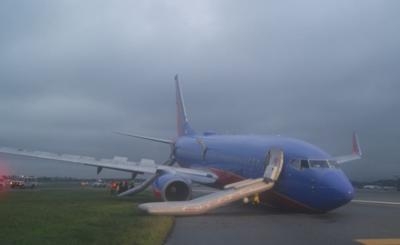
The plane's nose gear collapsed when the airplane landed nose-first on the runway. Everyone was evacuated from the airplane, and nine suffered non-life-threatening injuries. Traffic was snarled at LaGuardia for several hours.

According to the documents posted on the NTSB's accident docket, the captain of the airplane placed her hand over the co-pilot's hand on the throttles and pulled them back unexpectedly. She did not announce that she was taking control of the airplane ... "I got it" ... until it was about 50 feet above the runway, according to a report from the Wall Street Journal.

The 49-year-old captain was fired by Southwest about two months after the incident. At the time, she had more than 7,500 hours flying 737s. The NTSB indicates that about three years before the incident, she was required by the airline to take remedial training because of her management style. First Officers reportedly complained regularly about her "overbearing attitude" in the cockpit.

The co-pilot is still flying for Southwest.

The captain had initially disputed the account of the accident given to the NTSB by the co-pilot, but the data from the Cockpit Voice Recorder backed up the co-pilot's story.

According to the NTSB's documents, the captain became concerned that the airplane was too high on the approach and suddenly pulled back power to the engines at about 100 feet. With the flaps extended, the airplane nosed down, and she was unable to recover before the nose gear hit the runway. The force of the impact was calculated to be about three times the weight of the airplane ... all on the nose gear ... and the plane skidded for nearly 20 seconds down the runway.

(Image provided by the NTSB)

FMI: NTSB Accident Docket

Advertisement

More News

ANN's Daily Aero-Term (12.08.25): Decision Altitude (DA)

Decision Altitude (DA) A specified altitude (mean sea level (MSL)) on an instrument approach procedure (ILS, GLS, vertically guided RNAV) at which the pilot must decide whether to >[...]

ANN's Daily Aero-Linx (12.08.25)

Aero Linx: T-34 Association, Inc. The T-34 Association was formed in July 1975 so that individuals purchasing then military surplus T-34As had an organization which would provide s>[...]

NTSB Final Report: Piper PA-31T3

As He Released The Brakes To Begin Taxiing, The Brake Pedals Went To The Floor With No Braking Action Analysis: The pilot reported that during engine start up, he applied the brake>[...]

Aero-News: Quote of the Day (12.08.25)

“Legislation like the Mental Health in Aviation Act is still imperative to hold the FAA accountable for the changes they clearly acknowledge need to be made... We cannot wait>[...]

Airborne-Flight Training 12.04.25: Ldg Fee Danger, Av Mental Health, PC-7 MKX

Also: IAE Acquires Diamond Trainers, Army Drones, FedEx Pilots Warning, DA62 MPP To Dresden Tech Uni The danger to the flight training industry and our future pilots is clear. Dona>[...]

blog comments powered by Disqus



Advertisement

Advertisement

Podcasts

Advertisement

© 2007 - 2025 Web Development & Design by Pauli Systems, LC

