

Belite Aircraft Debuts At US Sport Aviation Expo In Sebring | Aero-News Network
Aero-News Network
RSS icon RSS feed
podcast icon MP3 podcast
Subscribe Aero-News e-mail Newsletter Subscribe

Airborne Unlimited -- Most Recent Daily Episodes

Episode Date

Airborne-Monday

Airborne-Tuesday

Airborne-Wednesday Airborne-Thursday

Airborne-Friday

Airborne On YouTube

Airborne-Unlimited-12.08.25

AirborneNextGen-
12.02.25

Airborne-Unlimited-12.03.25

Airborne-FltTraining-12.04.25

AirborneUnlimited-12.05.25

AFE 2025 LIVE MOSAIC Town Hall (Archived): www.airborne-live.net

Tue, Jan 26, 2010

Belite Aircraft Debuts At US Sport Aviation Expo In Sebring

First Showing Of The Tailwheel And Trike Models

Last spring, entrepreneur James Wiebe had an idea. As an avid pilot and aviation enthusiast, Wiebe wanted to create an aviation experience that would take recreational flight to a whole new realm. Wiebe acquired the tooling, existing parts and manufacturing rights of an older aircraft, then combined his creativity and experience from his previous business ventures to reinvent the design.  The result is a (FAR) Part 103 ultralight that looks and flies like a real airplane and a new aircraft company, Belite Aircraft. And this year, Belite Aircraft made its debut at the US Sport Aviation Expo in Sebring, Florida, last week.

FAR Part 103 airplanes have traditionally had great difficulty meeting legal weight requirements while providing airplane functionality. Wiebe developed a new lightweight carbon fiber process which solved this problem and offers an ultralight with the feel of a real airplane. The Belite incorporates stronger, lighter carbon fiber technologies to reduce the weight.  The result is a full-featured airplane that meets the 254 pound limit specified in FAR Part 103.

Wiebe has been refining the design and listening to prospects' suggestions and ideas.  As a result, he is introducing a Tricycle Gear version that offers easy takeoff and landing, eliminating the need for tailwheel training, and a Superlite version with outstanding Short Take Off and Landing (STOL) performance and rate of climb.

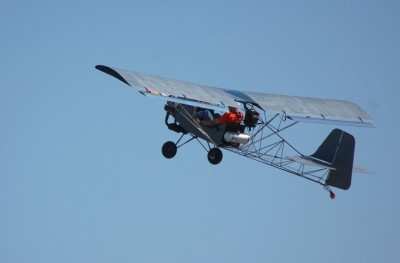
The standard Belite 254 is a full-featured, true single-seat airplane with a real instrument panel that is well within the Part 103 weight limits. A modern smooth and reliable 2-stroke engine allows a rate climb of 400 fpm and a cruise speed of 62 mph.  As a tailwheel airplane, it is remarkably easy to fly, but tailwheel operating knowledge is required. The standard Belite 254 has a control stick and rudder pedals for standard 3-axis aircraft controls, highly effective flapperons and classic taildragger styling.  It also features a tough welded 4130 steel frame and folding wings for easy transport and storage.

FMI: www.beliteaircraft.com

Advertisement

More News

NTSB Final Report: Patriot Aircraft LLC CX1900A

After Draining Both Wing Fuel Tanks, A Significant Amount Of Water Was Observed In The Right Wing Fuel Tank Analysis: The pilot, who was also the owner of the experimental amateur->[...]

Aero-News: Quote of the Day (12.06.25)

“Airbus apologises for any challenges and delays caused to passengers and airlines by this event. The Company thanks its customers, the authorities, its employees and all rel>[...]

ANN's Daily Aero-Term (12.06.25): High Speed Taxiway

High Speed Taxiway A long radius taxiway designed and provided with lighting or marking to define the path of aircraft, traveling at high speed (up to 60 knots), from the runway ce>[...]

ANN's Daily Aero-Linx (12.06.25)

Aero Linx: Taylorcraft Foundation, Inc. The Taylorcraft Foundation is exclusively organized for charitable, educational & scientific activities and will preserve the history an>[...]

Airborne-NextGen 12.02.25: Honda eVTOL, Arctus High-Alt UAS, Samson Patent

Also: USAF Reaper Accident, Baikonur Damage, Horizon eVTOL IFR/FIKI, New Glenn Update Honda has outlined its clearest timeline yet for its entry into the world of electric vertical>[...]

blog comments powered by Disqus



Advertisement

Advertisement

Podcasts

Advertisement

© 2007 - 2025 Web Development & Design by Pauli Systems, LC

