
Gone West: Dr. Forrest Bird | Aero-News Network
Aero-News Network
RSS icon RSS feed
podcast icon MP3 podcast
Subscribe Aero-News e-mail Newsletter Subscribe

Airborne Unlimited -- Most Recent Daily Episodes

Episode Date

Airborne-Monday

Airborne-Tuesday

Airborne-Wednesday Airborne-Thursday

Airborne-Friday

Airborne On YouTube

Airborne-Unlimited-12.01.25

AirborneNextGen-
12.02.25

Airborne-Unlimited-12.03.25

Airborne-AffordableFlyers-11.20.25

AirborneUnlimited-11.21.25

LIVE MOSAIC Town Hall (Archived): www.airborne-live.net

Wed, Aug 05, 2015

Gone West: Dr. Forrest Bird

Inventor And Pilot Was The Son Of A WWI Flying Ace

Inventor and pilot Dr. Forrest Bird passed away August 2 at his home in Sagle, ID, and during the final few days of his life, friends in their airplanes buzzed Bird's house and museum as a tribute to their colleague. "He loved the sound of the engines," wrote Bird's wife Pamela in an email to friends and supporters.

Bird was born on June 9, 1921 in Stoughton, MA, the son of a WWI flying ace who encouraged his interest in airplanes. According to CDAPRess.com, Bird had graduated high school at 14 years old and soloed in a Waco biplane. As a teenager, he met Orville Wright at the 1937 Cleveland Air Show.

During WWII, Bird was rated in every aircraft flown by the U.S. Armed Services. He flew over the Burma Hump with General George S. Patton, and flew a captured Junkers 88 at one point in the war.

That Ju-88 had a pressurized cabin, which gave the German's an altitude advantage over Allied pilots. Using a tin can, Bird developed the demand regulator that allowed Allied pilots to fly as high as 38,000 feet, and keep up with the Germans.

He was also credited with designing the first G-suit ... and inflatable jumpsuit that would help prevent loss of consciousness during high-G maneuvers.

Bird went on to became a doctor, and he adapted the demand regulator into a respirator to help patients breathe by forcing air into their lungs.

He was inducted in the National Inventors Hall of Fame in 1995.

Bird's residence is also a 16,000 square foot museum, in which many of his airplanes are stored. The museum also houses collectable cars and other artifacts, including some donated by NASA. The CDAPress reports that several of Bird's airplanes will be donated to the Smithsonian Institute.

Bird was 94. A few days before his passing, he was called by his friend Burt Rutan, who said "I talked to him for about 10 minutes and three times during my call I could hear the sound of airplanes buzzing his house on his museum airport. Cool."

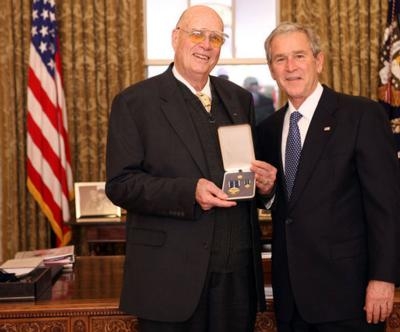
(Pictured: Dr. Forrest Bird receives the Citizen's Medal from then-President George W. Bush in 2008)

FMI: www.birdaviationmuseum.com

Advertisement

More News

Classic Aero-TV: VerdeGo Debuts VH-3 Hybrid-Electric Powerplant

From 2023 (YouTube Edition): New Propulsion Scheme Optimized for AAM Applications Founded in 2017 by Eric Bartsch, Pat Anderson, and Erik Lindbergh (grandson of famed aviation pion>[...]

NTSB Prelim: Grumman American Avn. Corp. AA-5B

During The Initial Climb, The Engine Began To Operate Abnormally And, After About Three Seconds, Experienced A Total Loss Of Power On October 29, 2025, about 1820 Pacific daylight >[...]

ANN's Daily Aero-Linx (12.02.25)

Aero Linx: Women in Aviation International Women in Aviation International is the largest nonprofit organization that envisions a world where the sky is open to all, and where avia>[...]

Aero-News: Quote of the Day (12.02.25)

“We’ve paid for the cable line’s repair for the customer and have apologized for the inconvenience this caused them...” Source: Some followup info from an A>[...]

Aero-News: Quote of the Day (12.03.25)

“We have long warned about the devastating effects of pairing optimization. Multiple times over many months, we highlighted how schedule manipulation, unbalanced schedules, a>[...]

blog comments powered by Disqus



Advertisement

Advertisement

Podcasts

Advertisement

© 2007 - 2025 Web Development & Design by Pauli Systems, LC

