
U.S. Bombers Respond To North Korea ICBM Launch | Aero-News Network
Aero-News Network
RSS icon RSS feed
podcast icon MP3 podcast
Subscribe Aero-News e-mail Newsletter Subscribe

Airborne Unlimited -- Most Recent Daily Episodes

Episode Date

Airborne-Monday

Airborne-Tuesday

Airborne-Wednesday Airborne-Thursday

Airborne-Friday

Airborne On YouTube

Airborne-Unlimited-12.01.25

AirborneNextGen-
12.02.25

Airborne-Unlimited-11.19.25

Airborne-AffordableFlyers-11.20.25

AirborneUnlimited-11.21.25

LIVE MOSAIC Town Hall (Archived): www.airborne-live.net

Fri, Aug 04, 2017

U.S. Bombers Respond To North Korea ICBM Launch

Conduct Bilateral Mission With Allies In The Region

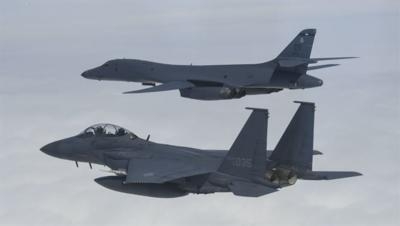
In response to North Korea's ballistic missile and nuclear programs and as a part of the continuing demonstration of ironclad U.S. commitment to its allies, two U.S. Air Force B-1B Lancer bombers under the command of U.S. Pacific Air Forces, joined their counterparts from South Korea and Japanese air forces in a sequenced bilateral mission July 29, 2017.

The mission was in direct response to North Korea's escalatory launch of intercontinental ballistic missiles July 3 and July 28.

"North Korea remains the most urgent threat to regional stability," said Gen. Terrence J. O'Shaughnessy, the Pacific Air Forces commander. "Diplomacy remains the lead; however, we have a responsibility to our allies and our nation to showcase our unwavering commitment while planning for the worst-case scenario. If called upon, we are ready to respond with rapid, lethal, and overwhelming force at a time and place of our choosing."

After taking off from Andersen Air Force Base, Guam, the B-1s flew to Japanese airspace, where they were joined by two Koku Jieitai (Japan Air Self Defense Force) F-2 fighter jets. The B-1s then flew over the Korean Peninsula where they were joined by four South Korean air force F-15 fighter jets. The B-1s then performed a low-pass over Osan Air Base, South Korea, before leaving South Korean airspace and returning to Guam.

Throughout the approximately 10-hour mission, the aircrews practiced intercept and formation training, enabling them to improve their combined capabilities and tactical skills, while also strengthening the long standing military-to-military relationships in the Indo-Asia-Pacific region.

U.S. Pacific Command maintains flexible bomber and fighter capabilities in the Indo-Asia-Pacific theater, retaining the ability to quickly respond to any regional threat in order to defend the U.S. homeland and in support of U.S. allies.

(Image provided with USAF news release)

FMI: www.af.mil

Advertisement

More News

ANN's Daily Aero-Term (12.01.25): Convective SIGMET

Convective SIGMET A weather advisory concerning convective weather significant to the safety of all aircraft. Convective SIGMETs are issued for tornadoes, lines of thunderstorms, e>[...]

ANN's Daily Aero-Linx (12.01.25)

Aero Linx: United Flying Octogenarians WELCOME to a most extraordinary group of aviators, the United Flying Octogenarians (UFO). Founded in 1982 with just a handful of pilots, we h>[...]

NTSB Final Report: Remos Aircraft GmbH Remos GX

Pilot’s Decision To Attempt Takeoff With Frost Covering The Airplane’s Wings Analysis: The pilot of the light sport airplane was preparing to depart for a cross-country>[...]

Aero-News: Quote of the Day (12.02.25)

“We’ve paid for the cable line’s repair for the customer and have apologized for the inconvenience this caused them...” Source: Some followup info from an A>[...]

ANN's Daily Aero-Term (12.02.25): Coupled Approach

Coupled Approach An instrument approach performed by the aircraft autopilot, and/or visually depicted on the flight director, which is receiving position information and/or steerin>[...]

blog comments powered by Disqus



Advertisement

Advertisement

Podcasts

Advertisement

© 2007 - 2025 Web Development & Design by Pauli Systems, LC

