Superman Would Be Proud
It's sorta like Superman's X-Ray vision, a new technology that
Johnson C. Smith University in Charlotte (NC) is developing for
potential applications in homeland security and aviation safety.
It's calledd PMMW - Passive Millimeter-Wave imaging.
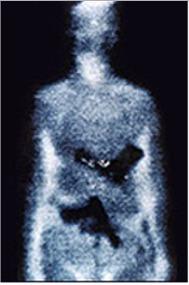
"The passive millimeter-wave imager is a camera that can detect
objects through clothing, dense fog, walls and other visibly opaque
materials using millimeter-wave radiation. One advantage is its
ability to see through severe weather conditions," said Dr. Alan
Lettington, professor emeritus at the University of Reading and a
world-renowned scientist in the field of PMMW imaging.
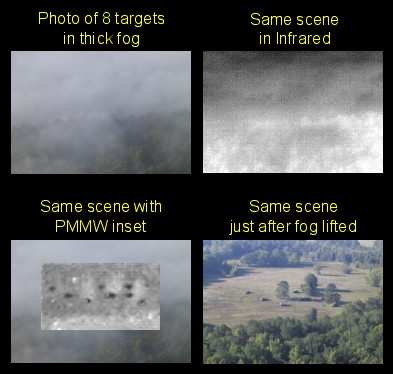
Could This Turn IMC Into Virtual Daytime VMC?
This project, funded by the NASA Glenn Research Center, has
allowed the passive millimeter-wave (PMMW) imager to be built and
delivered to JCSU for further evaluation and research. It may open
the door to new ways of handling airport security, aircraft
landing, space shuttle diagnostics and battlefield combat.
Currently, most air traffic control systems and surveillance
cameras use infrared waves, which are significantly weakened in
poor weather.
Another advantage to the PMMW imager is that objects are not
subject to external radiation in order to obtain an image. "This
technology makes it possible to detect objects without being
detected - that's why it's called passive," said Lettington.
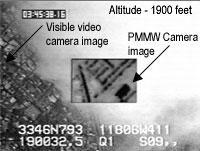 Four years ago, Dr. Magdy Attia, project director
and JCSU department chair of computer science and engineering,
collaborated with Lettington and the NASA Glenn Research Center to
study and develop the PMMW imager. The camera was recently
delivered to JCSU from England as a model for further research in
the US.
Four years ago, Dr. Magdy Attia, project director
and JCSU department chair of computer science and engineering,
collaborated with Lettington and the NASA Glenn Research Center to
study and develop the PMMW imager. The camera was recently
delivered to JCSU from England as a model for further research in
the US.
"Having this comprehensive engineering system at Johnson C.
Smith provides an excellent training ground for our students to
gain expertise in mm-wave technology as well as opens research
opportunities for faculty and other agencies," said Attia. Students
will begin research projects in the Fall.
Where's This Been All Our Lives?
 MM-wave research has been an underdeveloped area
until recently. During the past decade, attention has been
increased to utilize the technology to build surveillance cameras
for a wide spectrum of applications. Since September 11, potential
applications and interest in the development of PMMW imaging has
significantly increased. NASA, the US Department of Defense, and
other national organizations are looking at ways to reproduce the
imager for further research.
MM-wave research has been an underdeveloped area
until recently. During the past decade, attention has been
increased to utilize the technology to build surveillance cameras
for a wide spectrum of applications. Since September 11, potential
applications and interest in the development of PMMW imaging has
significantly increased. NASA, the US Department of Defense, and
other national organizations are looking at ways to reproduce the
imager for further research.
"Our primary interest in this technology is aviation safety. If
aircraft control towers or airplanes can be equipped with mm-wave
cameras, then even in adverse weather conditions, airports can
remain open with the least loss of productivity," said Dr. Isaiah
M. Blankson, senior scientist and technologist at NASA Glenn
Research Center. "NASA came to Johnson C. Smith because there was
real expertise in this area."
You Won't See This In Stores Anytime Soon
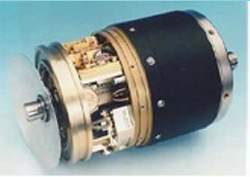 The PMMW imagers are expensive due to the high
cost of the millimeter-wave receivers needed to build them. A wide
spectrum of knowledge is needed in order to do research in this
field such as electromagnetic waves, microwave and millimeter-wave
antennas and devices, and super-resolution algorithms.
The PMMW imagers are expensive due to the high
cost of the millimeter-wave receivers needed to build them. A wide
spectrum of knowledge is needed in order to do research in this
field such as electromagnetic waves, microwave and millimeter-wave
antennas and devices, and super-resolution algorithms.
"Johnson C. Smith University has diligently worked to integrate
technology into all aspects of our curriculum. With this project,
we hope that others will not only recognize our commitment to
technology, but also appreciate our focus on research," said Dr.
Dorothy Cowser Yancy, JCSU president.



 Aero-News: Quote of the Day (12.11.25)


 See All