Contains Good News, Not So Good News About GA Operations
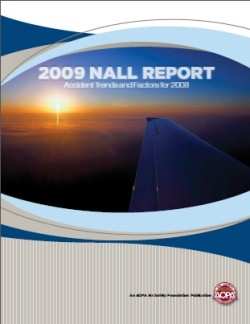
The new edition of the Joseph T. Nall Report, a review of
general aviation (GA) safety published by the Air Safety Institute
is now available online. It contains some surprisingly good news
about commercial GA operations, but raises significant concerns in
other areas.
"The Nall Report is, first and foremost, a teaching tool," said
Bruce Landsberg, president of ASI's parent organization, the AOPA
Foundation. "Those who choose to be safe by learning from others'
mistakes and avoiding risky flight operations have an above-average
safety record. It's perfectly logical. GA flying is as safe as the
pilot chooses to make it and there can be a wide continuum."
The current Nall Report is based on 2009 accident data - the
last year for which enough accident data are available to be
statistically valid and give a complete safety picture. As noted,
commercial GA operations - those conducted for compensation -
showed a marked improvement is their safety numbers. The number of
accidents on commercial fixed-wing (non-helicopter) flights
decreased by one-third from 2008, and the two fatal accidents -
both agricultural applications, or cropdusting, flights - represent
an 88% decrease from the previous year. No fatal accidents occurred
on fixed-wing charter or cargo flights.
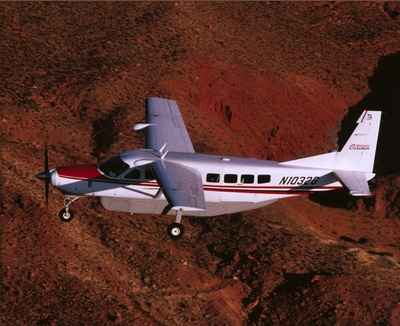
The commercial helicopter accident rate increased slightly from
2008, but is still markedly better than it was as recently as eight
years ago. The overall rate of commercial helicopter accidents has
decreased 71% since 2003, from 8.20 accidents per 100,000 flight
hours to 2.38. The fatal accident rate has been reduced by 85%
(from 2.14 to 0.32) over the same period. There were four fatal
accidents on commercial helicopter flights in 2009, resulting in 16
deaths, which is in the middle of the range for the preceding
decade. Fourteen of the sixteen fatalities were the result of only
two accidents; eight died when a helicopter transporting workers to
an oil rig crashed in the Gulf of Mexico; six died in the mid-air
collision of a sightseeing helicopter and private single-engine
fixed-wing aircraft over the Hudson River near Manhattan.
Among the concerns are that accidents due to mechanical causes
happened at a statistically significantly higher rate in 2009,
accounting for a record-high 17% of all non-commercial fixed-wing
accidents. Amateur-built aircraft continued to have significantly
higher rates of both fatal and non-fatal accidents than comparable
type-certificated aircraft, suffering particularly from greater
numbers of mechanical failures and unexplained losses of engine
power. More than half the fatal mechanical accidents occurred in
amateur-built airplanes.

Personal flights accounted for well under half of all
non-commercial fixed-wing flight time but had more than
three-quarters of all accidents and nearly 85% of fatal accidents.
Not surprisingly, nearly all (94%) of the accidents involving
private pilots were on personal flights, but a surprisingly high
number of the accidents involving commercial and airline transport
pilots were on personal flights: 60% of all accidents involving
commercial pilots and 67% of those suffered by ATPs.
The analysis from the Nall Report helps identify safety trends -
good or bad - and training opportunities where the Air Safety
Institute can focus its efforts.



 Aero-News: Quote of the Day (12.11.25)


 See All