Capabilities Of Conceptual Aircraft Are Already Known
While what is now being called "Future Vertical Lift", or FVL, by the Army is still a concept, its capabilities are already known. The FVL concept will be "able to support the Army and the ground commanders better than we can do it today," said Maj. Gen. Anthony G. Crutchfield, commander, U.S. Army Aviation Center of Excellence." I see this aircraft being able to do all the missions that we currently do. I see the aircraft that can do it because it can be scaled. It may be a medium variant, something that is the size of maybe a Black Hawk or an Apache is today, that can do the attack mission, or the assault/lift mission. I see the same aircraft scaled smaller that will be able to do the reconnaissance mission, similar to what a Kiowa Warrior does today."
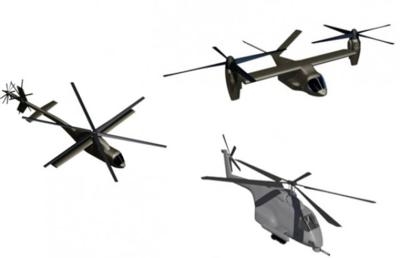
Crutchfield said it's not known if the FVL concept will end up producing a rotary-wing aircraft, like the Army AH-64 Apache, or a tilt-rotor aircraft like the Marine Corps MV-22 Osprey. What the FVL will do is perform missions the Army does today with its aviation assets, missions that will not change. "The vision is that we can have an aircraft that can do all the missions that we currently have," he said. "Our missions will not change. We still will do attack and reconnaissance, we still will do sustainment and troop movements. It's an enduring mission that will not change. I just want to do it better."
The FVL aircraft will perform multiple roles, Crutchfield said, and that means that the end result is that there will be fewer types of aircraft in the Army's fleet. It's also possible that there will be fewer aircraft overall, because a more capable aircraft means that fewer aircraft will be needed. "Today there are concepts where there are aircraft that we consider rotary wing, that can fly in excess of 300 knots," Crutchfield said. "No other aircraft we have today can fly 300 knots. If you have an aircraft that can fly 300 knots, it can cover more terrain faster, and if you can cover more terrain faster, theoretically, you would need less airframes to do the same type mission."
And because Crutchfield said the idea behind the FVL concept is to have the same aircraft be able to perform multiple missions, the Army will need fewer types of aircraft. That means a smaller number of parts will be needed to sustain the fleet, and a shared pool of maintainers and maintenance equipment. That will result in a reduced cost for logistics. Crutchfield said that the FVL could come in different sizes, depending on the mission it will perform, but things like engine, drive train, and cockpit components would be the same, common between the two, and swappable.
Today's Army aircraft, Crutchfield said, are capable. But there is a limit to the performance that can be squeezed from them. "Although we have great aircraft today, the best in the world, no matter how much money we invest in these aircraft of today - the aircraft are not going to fly any faster than they fly right now," Crutchfield said. "They are not going to be able to carry any more payload than they do right now. They will not be able to reduce any of the logistical footprint [more] than they do right now. That's what future vertical lift will do. That's what we see for the Army Aviation force of 2030."
It's expected that this summer, performance specifications for the FVL aircraft will be unveiled. Development of the program is an Army-led, joint program, that includes all military services, including the Coast Guard.



 Aero-News: Quote of the Day (12.11.25)


 See All