
Mars Phoenix Team Revises Soil Delivery Method | Aero-News Network
Aero-News Network
RSS icon RSS feed
podcast icon MP3 podcast
Subscribe Aero-News e-mail Newsletter Subscribe

Airborne Unlimited -- Most Recent Daily Episodes

Episode Date

Airborne-Monday

Airborne-Tuesday

Airborne-Wednesday Airborne-Thursday

Airborne-Friday

Airborne On YouTube

Airborne-Unlimited-12.08.25

AirborneNextGen-
12.09.25

Airborne-Unlimited-12.10.25

Airborne-AffordableFlyers-12.11.25

AirborneUnlimited-12.12.25

AFE 2025 LIVE MOSAIC Town Hall (Archived): www.airborne-live.net

Tue, Jun 10, 2008

Mars Phoenix Team Revises Soil Delivery Method

Just A Little Sprinkle Might Do It

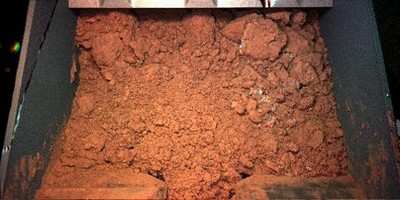
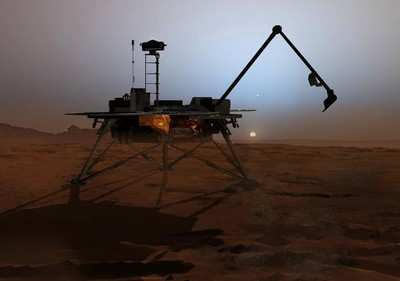
A revised method for delivering soil samples by the Robotic Arm to laboratory instruments on NASA's Phoenix Mars Lander may yield some success to failed earlier efforts now that researchers appreciate how clumpy the soil is at the landing site.

"We're a little surprised at how much this material is clumping together when we dig into it," said Doug Ming a Phoenix science team member from NASA's Johnson Space Center, Houston.

As reported Sunday by ANN, Phoenix’s instruments showed a vibrator on the screen -- designed to help shake soil into the chamber -- was working. But the electronic sensor to detect dirt falling into the Thermal and Evolved-Gas Analyzer (TEGA) chamber didn't report any particles.

The TEGA is designed to bake and sniff samples to identify some key ingredients central to the focus of the mission to determine if the northern permafrost region may have the ability to support life. The analyzer vibrated the screen for 20 minutes on Sunday but detected only a few particles of the challenging soil getting through the screen, not enough to fill the tiny oven below.

"We are going to try vibrating it one more time, and if that doesn't work, it is likely we will use our new, revised delivery method on another thermal analyzer cell," said William Boynton of the University of Arizona, lead scientist for the instrument.

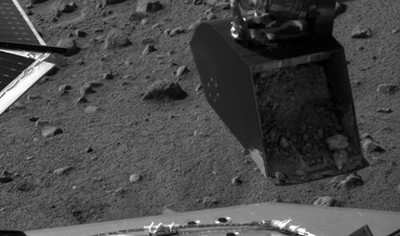
The initial method of delivery to get the first sample to TEGA on Friday required the arm to turn the scoop over and release it’s contents at once. A revised method requiring the arm to hold the scoop at an angle above the delivery target and sprinkle out a small amount of the sample by vibrating the scoop with a motorized rasp at the bottom was to be attempted Monday.

Sunday, Phoenix used the arm to collect a soil sample for the spacecraft's Optical Microscope. Monday’s plans included a practice of the sprinkle technique, using a small amount of soil from the sample collected Sunday.

If that goes well, the Phoenix team assembled at the University of Arizona plans to sprinkle material from the same scoopful onto the microscope later this week.

FMI: www.nasa.gov/phoenix, http://phoenix.lpl.arizona.edu

Advertisement

More News

ANN FAQ: Contributing To Aero-TV

How To Get A Story On Aero-TV News/Feature Programming How do I submit a story idea or lead to Aero-TV? If you would like to submit a story idea or lead, please contact Jim Campbel>[...]

Aero-News: Quote of the Day (12.10.25)

“As the excitement builds for the world of flight returning to Oshkosh in 2026, we wanted to ensure that advance tickets are available for those who enjoy giving AirVenture t>[...]

ANN's Daily Aero-Term (12.10.25): North Atlantic High Level Airspace (NAT HLA)

North Atlantic High Level Airspace (NAT HLA) That volume of airspace (as defined in ICAO Document 7030) between FL 285 and FL 420 within the Oceanic Control Areas of Bodo Oceanic, >[...]

Airborne 12.08.25: Samaritan’s Purse Hijack, FAA Med Relief, China Rocket Fail

Also: Cosmonaut Kicked Out, Airbus Scales Back, AF Silver Star, Russian A-60 Clobbered A Samaritan’s Purse humanitarian flight was hijacked on Tuesday, December 2, while atte>[...]

Airborne-Flight Training 12.04.25: Ldg Fee Danger, Av Mental Health, PC-7 MKX

Also: IAE Acquires Diamond Trainers, Army Drones, FedEx Pilots Warning, DA62 MPP To Dresden Tech Uni The danger to the flight training industry and our future pilots is clear. Dona>[...]

blog comments powered by Disqus



Advertisement

Advertisement

Podcasts

Advertisement

© 2007 - 2025 Web Development & Design by Pauli Systems, LC

