
Hurricane Michael: FAA Information For Drone Operators | Aero-News Network
Aero-News Network
RSS icon RSS feed
podcast icon MP3 podcast
Subscribe Aero-News e-mail Newsletter Subscribe

Airborne Unlimited -- Most Recent Daily Episodes

Episode Date

Airborne-Monday

Airborne-Tuesday

Airborne-Wednesday Airborne-Thursday

Airborne-Friday

Airborne On YouTube

Airborne-Unlimited-12.08.25

AirborneNextGen-
12.09.25

Airborne-Unlimited-12.10.25

Airborne-FltTraining-12.04.25

AirborneUnlimited-12.05.25

AFE 2025 LIVE MOSAIC Town Hall (Archived): www.airborne-live.net

Thu, Oct 11, 2018

Hurricane Michael: FAA Information For Drone Operators

Fines For Flying In Restricted Areas May Exceed $20,000

The FAA is warning drone owners and operators that they will be subject to significant fines that may exceed $20,000 if they interfere with emergency response operations in the areas affected by Hurricane Michael.

Many aircraft that are conducting life-saving missions and other critical response and recovery efforts are likely to be flying at low altitudes over areas affected by the storm. Flying a drone without authorization in or near the disaster area may unintentionally disrupt rescue operations and violate federal, state, or local laws and ordinances, even if a Temporary Flight Restriction (TFR) is not in place. Allow first responders to save lives and property without interference.

Government agencies with an FAA Certificate of Authorization (COA) or flying under Part 107, as well as private sector Part 107 drone operators who want to support response and recovery operations, are strongly encouraged to coordinate their activities with the local incident commander responsible for the area in which they want to operate.

If drone operators need to fly in controlled airspace or a disaster TFR to support the response and recovery, operators must contact the FAA’s System Operations Support Center (SOSC) by emailing 9-ATOR-HQ-SOSC@faa.gov the information they need to authorize access to the airspace. Coordination with the SOSC may also include a requirement that a drone operator obtain support from the appropriate incident commander.

Here’s the information the FAA may require:

  • the unmanned aircraft type
  • a PDF copy of a current FAA COA
  • the pilot’s Part 107 certificate number
  • details about the proposed flight (date, time, location, altitude, direction and distance to the nearest airport, and latitude/longitude)
  • nature of the event (fire, law enforcement, local/national disaster, missing person) and the pilot’s qualification information.

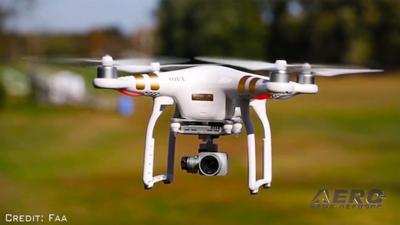
(Source: FAA news release. Image from file)

FMI: www.faa.gov

Advertisement

More News

ANN's Daily Aero-Term (12.08.25): Decision Altitude (DA)

Decision Altitude (DA) A specified altitude (mean sea level (MSL)) on an instrument approach procedure (ILS, GLS, vertically guided RNAV) at which the pilot must decide whether to >[...]

ANN's Daily Aero-Linx (12.08.25)

Aero Linx: T-34 Association, Inc. The T-34 Association was formed in July 1975 so that individuals purchasing then military surplus T-34As had an organization which would provide s>[...]

NTSB Final Report: Piper PA-31T3

As He Released The Brakes To Begin Taxiing, The Brake Pedals Went To The Floor With No Braking Action Analysis: The pilot reported that during engine start up, he applied the brake>[...]

Aero-News: Quote of the Day (12.08.25)

“Legislation like the Mental Health in Aviation Act is still imperative to hold the FAA accountable for the changes they clearly acknowledge need to be made... We cannot wait>[...]

Airborne-Flight Training 12.04.25: Ldg Fee Danger, Av Mental Health, PC-7 MKX

Also: IAE Acquires Diamond Trainers, Army Drones, FedEx Pilots Warning, DA62 MPP To Dresden Tech Uni The danger to the flight training industry and our future pilots is clear. Dona>[...]

blog comments powered by Disqus



Advertisement

Advertisement

Podcasts

Advertisement

© 2007 - 2025 Web Development & Design by Pauli Systems, LC

