
AW609 Tiltrotor In Final Production Configuration Flies In Philadelphia | Aero-News Network
Aero-News Network
RSS icon RSS feed
podcast icon MP3 podcast
Subscribe Aero-News e-mail Newsletter Subscribe

Airborne Unlimited -- Most Recent Daily Episodes

Episode Date

Airborne-Monday

Airborne-Tuesday

Airborne-Wednesday Airborne-Thursday

Airborne-Friday

Airborne On YouTube

Airborne-SpecialEpisode-12.15.25

AirborneNextGen-
12.16.25

Airborne-Unlimited-12.10.25

Airborne-AffordableFlyers-12.11.25

AirborneUnlimited-12.12.25

AFE 2025 LIVE MOSAIC Town Hall (Archived): www.airborne-live.net

Thu, Jan 02, 2020

AW609 Tiltrotor In Final Production Configuration Flies In Philadelphia

Program Enters Into Its Final Development And Ground/Flight Testing Stages

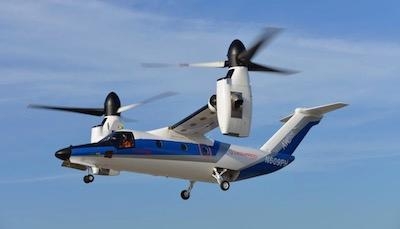
The fourth AW609 tiltrotor, fully representative of the final production configuration, successfully performed its first flight at Leonardo’s Philadelphia plant on Dec. 23, entering the final program development and ground/flight testing stages.

Lifting off on a clear afternoon, test pilot Dan Wells said, “The aircraft performed beautifully, thanks to all the rig and ground testing and the work done by our amazing engineering and production teams. The new touch-screen cockpit layout really proved its value and the aircraft exceeded all of our expectations.”

With this flight, the world’s first multirole commercial tiltrotor achieved a major milestone on its path to FAA certification. The AW609 will be certified under the FAA’s new Powered Lift category, the first new category of aircraft certified by the FAA in decades. Combining the vertical take-off and landing performance of a helicopter with the speed, range, and comfort of a turboprop airplane, the AW609 is poised to transform private and downtown to downtown transport, emergency medical service (EMS), search-and-rescue (SAR), offshore operations and patrol, among other uses.

The AW609 carries up to nine passengers in a comfortable pressurized cabin, has a max cruise speed of 275 knots and can travel up to 700 nautical miles — about twice as fast and twice as far as the typical helicopter. It climbs to 25,000 feet, flying safely above inclement weather and in known icing conditions.

The AW609 features fly-by-wire flight controls, Collins Aerospace Pro Line Fusion avionics and two Pratt & Whitney PT6C-67A engines.

(Image provided with Leonardo Company news release)

FMI: www.leonardocompany.com

Advertisement

More News

ANN's Daily Aero-Term (12.19.25): Ultrahigh Frequency (UHF)

Ultrahigh Frequency (UHF) The frequency band between 300 and 3,000 MHz. The bank of radio frequencies used for military air/ground voice communications. In some instances this may >[...]

NTSB Prelim: Cirrus Design Corp SR22T

During The 7 Second Descent, There Was Another TAWS Alert At Which Time The Engine Remained At Full Power On October 24, 2025 at 2115 mountain daylight time, a Cirrus SR22T, N740TS>[...]

Classic Aero-TV: The Red Tail Project--Carrying the Torch of the Tuskegee Airmen

From 2009 (YouTube Edition): Educational Organization Aims to Inspire by Sharing Tuskegee Story Founding leader Don Hinz summarized the Red Tail Project’s mission in simple, >[...]

Aero-News: Quote of the Day (12.19.25)

“This feels like an important step since space travel for people with disabilities is still in its very early days... I’m so thankful and hope it inspires a change in m>[...]

Airborne 12.17.25: Skydiver Hooks Tail, Cooper Rotax Mount, NTSB v NDAA

Also: New Katanas, Kern County FD Training, IndiGo’s Botched Roster, MGen. Leavitt Named ERAU Dean The Australian Transportation Safety Bureau (ATSB) has wrapped up its inves>[...]

blog comments powered by Disqus



Advertisement

Advertisement

Podcasts

Advertisement

© 2007 - 2025 Web Development & Design by Pauli Systems, LC

