Fri, May 02, 2025
Last Of Four Fighting Falcons Arrives At Eglin AFB
The last of four F-16 Fighting Falcons slated for autonomous modification arrived at Eglin Air Force Base in Florida on April 1 under the Viper Experimentation and Next-gen Operations Model – Autonomy Flying Testbed program, or VENOM.
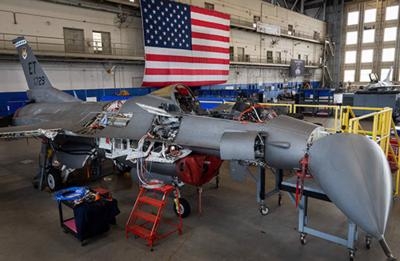
Three of the aircraft are in various phases of the modification process, which involves hardware, software, and instrumentation that will enable the aircraft to fly autonomously. One of the new physical mods is the inclusion of an auto-throttle that will allow the autonomy flying VENOM to regulate the thrust and flight control surfaces.
Maj. Trent McMullen, 40th Flight Test Squadron Advanced Capabilities Division Chief said, “Modifying the aircraft is the result of a rigorous design phase and brings us one step closer to testing autonomy on a fighter jet with real mission systems and capabilities.”
While the aircraft are being physically modified, the to-be-used autonomy is continually being tested in faster-than-real-time modeling and simulation environments in countless combat aircraft scenarios.
The simulations, which began in 2024, started with one-on-one and have progressed to two-on-two combat flights that also include within-visual-range as well as beyond-visual-range missions.
McMullen explained, “These simulations provide an efficient way to train the autonomy to learn complex air combat tactics. A specific scenario can be run 1,000 times and the variations and decisions made throughout that mission can be studied. We can then make recommendations to the developers on how to improve the autonomy’s behaviors and overall performance.”
The next step for the development of VENOM will be the integration of hardware and software-in-the-loop testing to ensure that the VENOM autonomy connects and communicates with the aircraft systems correctly.
Additional steps will also focus on safety to ensure that the autonomous commands cannot break the aircraft or the pilot. This will ensure that the autonomy can’t go past its limits or exceed the flight envelope regardless of the commands it receives. This will be performed in an F-16 flight simulator.
More News
Waypoint A predetermined geographical position used for route/instrument approach definition, progress reports, published VFR routes, visual reporting points or points for transiti>[...]
Aero Linx: Sentimental Journey to Cub Haven Sentimental Journey Flyin began in 1986 with a group of dedicated volunteers working to provide a sentimental return to Lock Haven, the >[...]
The Pilot Would Often Fly Over Their House At A Low Altitude And That Family Members Would Go Outside To Wave On November 14, 2025, at 1708 eastern standard time, a Jabiru USA Spor>[...]
From 2024 (YouTube Edition): Volatus Infrastructure Paves The Way The name “Volatus” seems to be everywhere these days, popping up in a series of partnerships and proje>[...]
Fortnite Conquers All, Klyde FMI: www.klydemorris.com>[...]



 ANN's Daily Aero-Term (11.29.25): Waypoint


 See All